LPAR5 Antibody

Code: CSB-PA002795
Size:
50μg
50μg100μg
US$119
Quantity:
Species Reactivity: Human
Raised in: Rabbit
Application: WB, IHC, IF, ELISA
For inquiries on large quantities or another requirements
Send an Inquiry
Start an on-line Chat
Online ordering is currently available for U.S. customers only. For orders outside the U.S., please kindly submit an inquiry or start a chat with us.

Product Details

Uniprot NO.
Target Names
LPAR5
Alternative Names
LPAR5; GPR92; GPR93; Lysophosphatidic acid receptor 5; LPA receptor 5; LPA-5; G-protein coupled receptor 92; G-protein coupled receptor 93
Raised in
Rabbit
Species Reactivity
Human
Immunogen
Synthesized peptide derived from the Internal region of Human GPR92.
Immunogen Species
Homo sapiens (Human)
Conjugate
Non-conjugated
Isotype
IgG
Purification Method
The antibody was affinity-purified from rabbit antiserum by affinity-chromatography using epitope-specific immunogen.
Concentration
It differs from different batches. Please contact us to confirm it.
Buffer
Liquid in PBS containing 50% glycerol, 0.5% BSA and 0.02% sodium azide.
Tested Applications
WB, IHC, IF, ELISA
Storage
Upon receipt, store at -20°C or -80°C. Avoid repeated freeze.
Lead Time
Basically, we can dispatch the products out in 1-3 working days after receiving your orders. Delivery time maybe differs from different purchasing way or location, please kindly consult your local distributors for specific delivery time.
Note: All of our proteins are default shipped with normal blue ice packs, if you request to ship with dry ice, please communicate with us in advance and extra fees will be charged.
Usage
For Research Use Only. Not for use in diagnostic or therapeutic procedures.
Datasheet & COA
Images
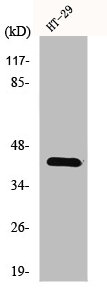
  • Western Blot analysis of K562 cells using GPR92 Polyclonal Antibody

Customer Reviews and Q&A

 Customer Reviews

Target Background

Function(From Uniprot)
Receptor for lysophosphatidic acid (LPA), a mediator of diverse cellular activities.
Gene References into Functions
  1. It signaling may play a key role in the mechanisms underlying neuropathic pain following demyelination in the brain. PMID:29409686
  2. These results suggest that the cell motile activity is regulated through the induction of LPA5 by phorbol ester and anticancer drug treatments in A375cells. PMID:29309788
  3. These results suggest that the diverse roles of LPA4, LPA5 and LPA6 are involved in the activation of tumor progression in pancreatic cancer cells. PMID:25849892
  4. Down-regulation of LPA receptor 5 contributes to aberrant LPA signalling in EBV-associated nasopharyngeal carcinoma. PMID:25294670
  5. MMP-2 and MMP-9 were found in HT1080L5 cells, in comparison with control cells. These results suggest that LPA signaling via LPA5 negatively regulates the cell motile and invasive activities of human sarcoma cells. PMID:24676544
  6. These results suggest that LPA5 may act as a negative regulator of cellular responses in mouse fibroblast 3T3 cells, similar to the case for LPA1. PMID:24632199
  7. It was shown that lysophosphatidic acid 5 receptor transactivated the epidermal growth factor receptor and that inhibition of epidermal growth factor receptor blocked lysophosphatidic acid 5 receptor-dependent activation of NHE3. PMID:21832242
  8. LPA5 is a bona fide LPA receptor on human mast cells responsible for the majority of LPA induced MIP-1beta release. PMID:21464938
  9. LPA4 and LPA5 receptors induce osteoblastic differentiation of human mesenchymal stem cells PMID:20069565
  10. Data show that CLL cells express LPA receptors LPA(1-5) and VEGF receptors, and the plasma levels of VEGF are elevated in CLL patients. PMID:19860625
  11. GPR92 is proposed as a fifth LPA receptor, LPA5, which likely has distinct physiological functions in view of its expression pattern. PMID:16774927
  12. FPP and NAG play a role in the sensory nervous system through activation of GPR92 PMID:18499677
  13. Four residues involved in ligand recognition in LPA(5) were identified as follows: R2.60N mutant abolished receptor activation, whereas H4.64E, R6.62A, and R7.32A greatly reduced receptor activation. PMID:19366702

Show More

Hide All

Subcellular Location
Cell membrane; Multi-pass membrane protein.
Protein Families
G-protein coupled receptor 1 family
Tissue Specificity
Not expressed in frontal cortex, basal forebrain, caudate putamen, thalamus, or hippocampus.
Database Links

HGNC: 13307

UNIGENE: Hs.155538

KEGG: hsa:57121

STRING: 9606.ENSP00000327875

OMIM: 606926

icon of phone
Call us
301-363-4651 (Available 9 a.m. to 5 p.m. CST from Monday to Friday)

icon of address
Address
No. 269, Shendun 5th Road, Donghu Hi-Tech Development Area, Hubei Province, 430206, P.R.China
icon of social media
Join us with

Subscribe newsletter

Leave a message

* To protect against spam, please pass the CAPTCHA test below.
CAPTCHA verification
© 2007-2025 CUSABIO TECHNOLOGY LLC All rights reserved. 鄂ICP备15011166号-1
Select 0 Products