* Sample kit cost can be deducted as a $30 credit for each 96-assay kit of the same analyte and brand you subsequently purchase within six months until depleted. More details >>
Interested in a trial size? Please leave a message below.


Intra-assay Precision (Precision within an assay): CV%<8% | ||||||
Three samples of known concentration were tested twenty times on one plate to assess. | ||||||
Inter-assay Precision (Precision between assays): CV%<10% | ||||||
Three samples of known concentration were tested in twenty assays to assess. | ||||||
To assess the linearity of the assay, samples were spiked with high concentrations of rat IL-1β in various matrices and diluted with the Sample Diluent to produce samples with values within the dynamic range of the assay. | ||||||
| Sample | Serum(n=4) | ||||
1:1 | Average % | 88 | ||||
Range % | 80-96 | |||||
1:2 | Average % | 92 | ||||
Range % | 90-105 | |||||
1:4 | Average % | 94 | ||||
Range % | 91-103 | |||||
1:8 | Average % | 93 | ||||
Range % | 86-98 | |||||
The recovery of rat IL-1β spiked to levels throughout the range of the assay in various matrices was evaluated. Samples were diluted prior to assay as directed in the Sample Preparation section. | ||||||
Sample Type | Average % Recovery | Range | ||||
Serum (n=5) | 95 | 89-98 | ||||
EDTA plasma (n=4) | 99 | 90-105 | ||||
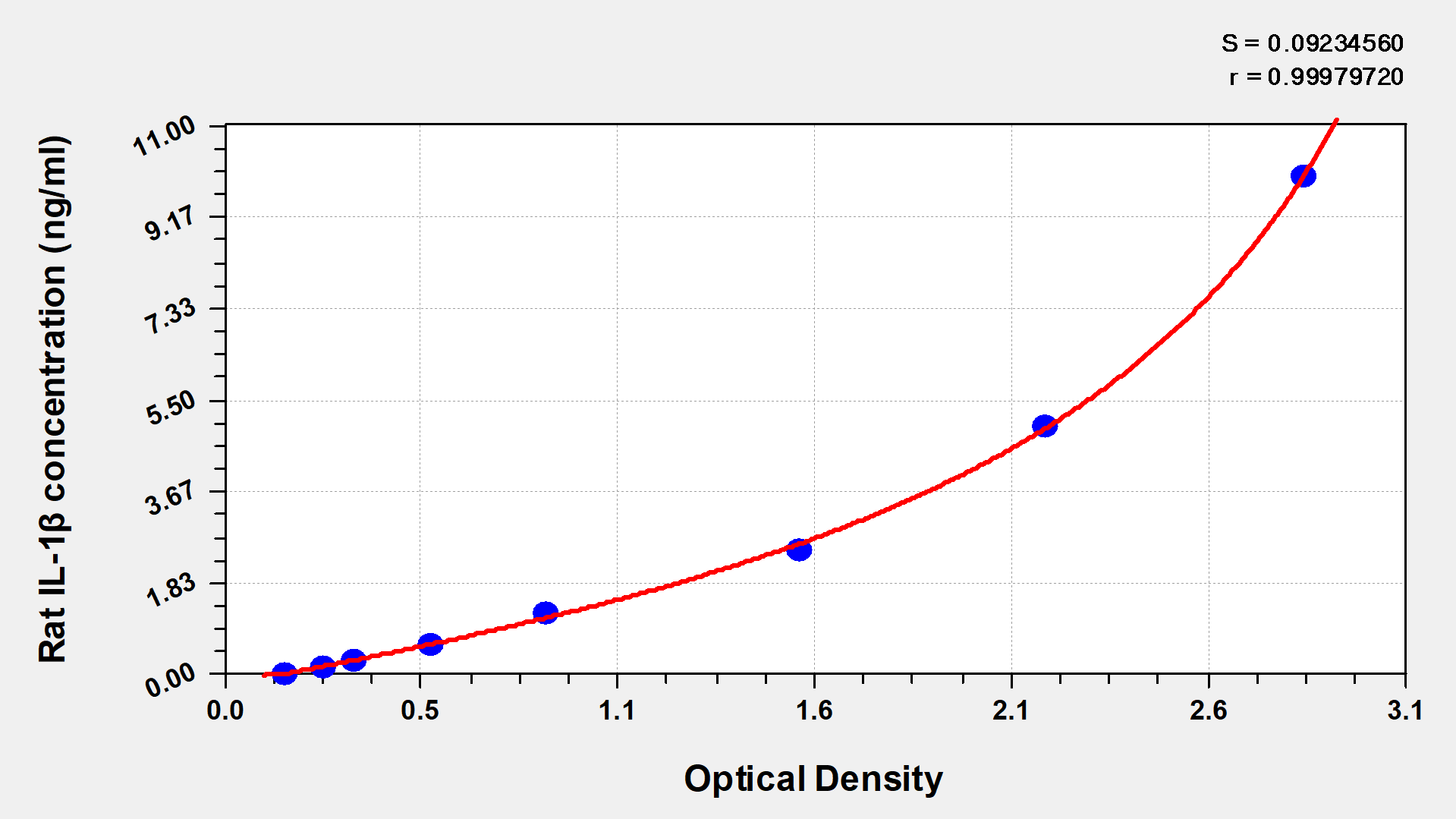
These standard curves are provided for demonstration only. A standard curve should be generated for each set of samples assayed. | |||||||
| |||||||
ng/ml | OD1 | OD2 | Average | Corrected | |||
10 | 2.903 | 2.834 | 2.868 | 2.689 | |||
5 | 2.208 | 2.167 | 2.187 | 2.008 | |||
2.5 | 1.563 | 1.508 | 1.536 | 1.356 | |||
1.25 | 0.872 | 0.859 | 0.865 | 0.686 | |||
0.625 | 0.579 | 0.551 | 0.565 | 0.386 | |||
0.312 | 0.363 | 0.353 | 0.358 | 0.178 | |||
0.156 | 0.284 | 0.274 | 0.279 | 0.099 | |||
0 | 0.184 | 0.175 | 0.180 |
| |||
Interleukin-1 beta (IL-1β) is a potent pro-inflammatory cytokine that plays a central role in immune responses and inflammatory processes. Activated macrophages, monocytes, and other immune cells produce this cytokine in response to pathogens and tissue damage. IL-1β acts as a key mediator in starting and amplifying inflammatory cascades. It influences fever induction, acute-phase protein synthesis, and T-helper cell activation. Dysregulation of IL-1β has been linked to numerous inflammatory diseases and autoimmune conditions, making it an important target for immunological research.
The Rat Interleukin 1β,IL-1β ELISA Kit (CSB-E08055r) provides quantitative measurement of IL-1β in rat samples using a sandwich assay principle. This kit works with serum, plasma, and tissue homogenates. The detection range spans 0.156 ng/ml to 10 ng/ml with sensitivity of 0.039 ng/ml. The assay requires 50-100μl sample volume and takes 1-5 hours to complete. Detection occurs at 450 nm wavelength, giving researchers a reliable tool for studying IL-1β levels in Rattus norvegicus samples.
Application Examples
Note: The following application examples are drawn from a selection of publications citing this product. For additional applications, please refer to the full list of references in the "Citations" section.
Researchers have used this ELISA kit to study inflammatory responses and tissue-specific protein expression changes in rat models. Studies have measured interleukin-1 beta levels in various biological samples including serum and tissue homogenates such as hippocampal preparations.
• Inflammatory cytokine profiling - Quantifying interleukin-1 beta alongside other pro-inflammatory markers in multi-analyte panels to determine inflammatory status
• Neuroinflammation research - Measuring interleukin-1 beta expression in hippocampal tissue homogenates to evaluate neuroinflammatory responses
• Herbal medicine studies - Testing anti-inflammatory effects of traditional Chinese medicine formulations on cytokine expression patterns
• Infectious disease models - Evaluating inflammatory responses in bacterial infection studies using streptococcal challenge models
• Cardiovascular research - Analyzing serum interleukin-1 beta concentrations in cardiac studies examining inflammatory biomarkers
• Apoptosis and inflammation correlation - Studying relationships between inflammatory cytokine levels and apoptotic pathway markers in tissue samples
• Therapeutic intervention studies - Monitoring interleukin-1 beta levels to determine treatment efficacy in anti-inflammatory drug research

Sample species :
Sample type:
Sample dilution:
Review:
By Anonymous
UNIGENE: Rn.9869
STRING: 10116.ENSRNOP00000006308


Email: support@cusabio.com
Distributors Worldwide


