* Sample kit cost can be deducted as a $30 credit for each 96-assay kit of the same analyte and brand you subsequently purchase within six months until depleted. More details >>
Interested in a trial size? Please leave a message below.


| Intra-assay Precision (Precision within an assay): CV%<8% | ||||||
| Three samples of known concentration were tested twenty times on one plate to assess. | ||||||
| Inter-assay Precision (Precision between assays): CV%<10% | ||||||
| Three samples of known concentration were tested in twenty assays to assess. | ||||||
| To assess the linearity of the assay, samples were spiked with high concentrations of rat NE in various matrices and diluted with the Sample Diluent to produce samples with values within the dynamic range of the assay. | ||||||
| Sample | Serum(n=4) | |||||
| 1:1 | Average % | 89 | ||||
| Range % | 83-93 | |||||
| 1:2 | Average % | 85 | ||||
| Range % | 80-90 | |||||
| 1:4 | Average % | 91 | ||||
| Range % | 83-95 | |||||
| 1:8 | Average % | 93 | ||||
| Range % | 86-97 | |||||
| The recovery of rat NE spiked to levels throughout the range of the assay in various matrices was evaluated. Samples were diluted prior to assay as directed in the Sample Preparation section. | ||||||
| Sample Type | Average % Recovery | Range | ||||
| Serum (n=5) | 97 | 92-102 | ||||
| EDTA plasma (n=4) | 95 | 90-100 | ||||
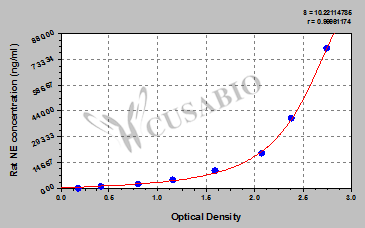
| These standard curves are provided for demonstration only. A standard curve should be generated for each set of samples assayed. | |||||||||||||||||||||||||||||||||||||||||||||||||||||||||||||||
|
|||||||||||||||||||||||||||||||||||||||||||||||||||||||||||||||
Neutrophil elastase is a serine protease primarily stored in the azurophilic granules of neutrophils and released during inflammatory responses and degranulation. This enzyme plays key roles in antimicrobial defense by degrading bacterial proteins and helping neutrophil migration through extracellular matrix components. NE also participates in various pathological processes including tissue damage during excessive inflammation, chronic obstructive pulmonary disease, and acute lung injury. Its proteolytic activity against elastin and other structural proteins makes it an important biomarker for neutrophil activation and inflammatory conditions in research settings.
The Rat neutrophil elastase ELISA Kit (CSB-E08847r) uses a quantitative sandwich measurement principle for detecting NE in Rattus norvegicus samples. This assay works with serum, plasma, cell culture supernates, tissue homogenates, and cell lysates. The detection range spans 12.5 ng/mL to 800 ng/mL with sensitivity of 3.12 ng/mL. The protocol requires 50-100 μL sample volume and can be completed within 1-5 hours, with detection performed at 450 nm wavelength.
Application Examples
Note: The following application examples are drawn from a selection of publications citing this product. For additional applications, please refer to the full list of references in the "Citations" section.
This ELISA kit has been used in research studying neutrophil extracellular trap (NET) biomarkers and cardiovascular-related studies. Applications range from measuring circulating biomarkers in plasma samples to testing therapeutic interventions in experimental models.
• NET biomarker research: Measuring neutrophil elastase levels in plasma as part of comprehensive NET biomarker panels including cell-free DNA and histone modifications
• Cardiovascular pharmacology: Testing neutrophil elastase alongside other inflammatory and vasoactive mediators in studies examining therapeutic compounds and cardiovascular interventions
• Plasma biomarker profiling: Measuring neutrophil elastase in circulation as part of multi-analyte approaches to characterize inflammatory and vascular responses


