Recombinant Human Intestinal-type alkaline phosphatase (ALPI) (Active)

In Stock
Code: CSB-MP001627HU
Size:
20ug
20ug100ug1mg
US$136
Quantity:
Express system: Mammalian cell
Species: Homo sapiens (Human)
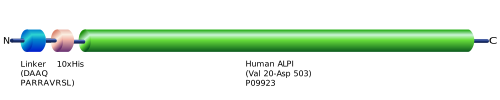
Tag Info: N-terminal 10xHis-tagged
For inquiries on large quantities or another requirements
Send an Inquiry
Start an on-line Chat
Online ordering is currently available for U.S. customers only. For orders outside the U.S., please kindly submit an inquiry or start a chat with us.

Product Details

Abbreviation
Recombinant Human ALPI protein (Active)
Purity
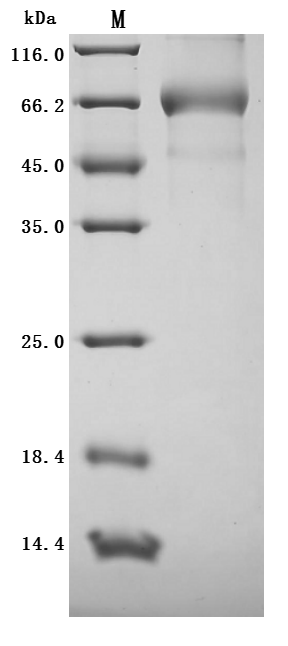
Greater than 95% as determined by SDS-PAGE.
Endotoxin
Less than 1.0 EU/ug as determined by LAL method.
Activity
Unit Definition: One unit is defined as the amount of enzyme required to cleave 1 nmol p-nitro-phenylphosphate (pNPP), in 1 minute at 37°C, pH10.0. The specific activity is > 8836.463 U/mg.
Target Names
ALPI
Uniprot NO.
Alternative Names
(IAP)(Intestinal alkaline phosphatase)
Molecular Characterization
Species
Homo sapiens (Human)
Source
Mammalian cell
Expression Region
20-503aa
Target Protein Sequence
VIPAEEENPAFWNRQAAEALDAAKKLQPIQKVAKNLILFLGDGLGVPTVTATRILKGQKNGKLGPETPLAMDRFPYLALSKTYNVDRQVPDSAATATAYLCGVKANFQTIGLSAAARFNQCNTTRGNEVISVMNRAKQAGKSVGVVTTTRVQHASPAGTYAHTVNRNWYSDADMPASARQEGCQDIATQLISNMDIDVILGGGRKYMFPMGTPDPEYPADASQNGIRLDGKNLVQEWLAKHQGAWYVWNRTELMQASLDQSVTHLMGLFEPGDTKYEIHRDPTLDPSLMEMTEAALRLLSRNPRGFYLFVEGGRIDHGHHEGVAYQALTEAVMFDDAIERAGQLTSEEDTLTLVTADHSHVFSFGGYTLRGSSIFGLAPSKAQDSKAYTSILYGNGPGYVFNSGVRPDVNESESGSPDYQQQAAVPLSSETHGGEDVAVFARGPQAHLVHGVQEQSFVAHVMAFAACLEPYTACDLAPPACTTD
Note: The complete sequence may include tag sequence, target protein sequence, linker sequence and extra sequence that is translated with the protein sequence for the purpose(s) of secretion, stability, solubility, etc.
If the exact amino acid sequence of this recombinant protein is critical to your application, please explicitly request the full and complete sequence of this protein before ordering.
Mol. Weight
55.2 kDa
Protein Length
Full Length of Mature Protein
Tag Info
N-terminal 10xHis-tagged
The tag type will be determined during production process. If you have specified tag type, please tell us and we will develop the specified tag preferentially.
Buffer
Lyophilized from a 0.2 μm filtered 20 mM Tris-HCl, 0.5 M NaCl, 6% Trehalose, pH 8
Storage
Store at -20°C/-81°C upon receipt, aliquoting is necessary for mutiple use. Avoid repeated freeze-thaw cycles.
Lead Time
Basically, we can dispatch the products out in 3-7 working days after receiving your orders. Delivery time may differ from different purchasing way or location, please kindly consult your local distributors for specific delivery time.
Note: All of our proteins are default shipped with normal blue ice packs, if you request to ship with dry ice, please communicate with us in advance and extra fees will be charged.
Notes
Repeated freezing and thawing is not recommended. Store working aliquots at 4°C for up to one week.
Shelf Life
The shelf life is related to many factors, storage state, storage temperature and the stability of the product itself. Generally, the shelf life of lyophilized form is 6 months at -20°C/-80°C from the date of receipt.
Troubleshooting and FAQs
Datasheet & COA
Please contact us to get it.
Images
  • (Tris-Glycine gel) Discontinuous SDS-PAGE (reduced) with 5% enrichment gel and 15% separation gel.
Description

Human intestinal alkaline phosphatase (ALPI) plays a critical role in gut barrier defense and lipopolysaccharide detoxification, making precise enzymatic characterization essential for understanding its physiological functions. This recombinant form, covering residues 20–503 of the mature protein with an N-terminal 10xHis tag positioned away from the catalytic domain, demonstrates a specific activity exceeding 8,836 U/mg against pNPP at 37°C and pH 10.0—providing a reliable foundation for kinetic parameter analysis (Km, Vmax, kcat), substrate specificity profiling, and inhibitor screening with accurate IC50 determination. The preparation satisfies the purity and endotoxin criteria typical for sensitive enzymatic assays, with greater than 95% purity by SDS-PAGE and less than 1.0 EU/μg by LAL, supporting use as a positive control in enzyme-linked assays or in drug candidate evaluation studies requiring minimal background interference. Researchers can confidently employ this protein for mechanistic inhibition studies and structural investigations where high homogeneity is paramount.


Customer Reviews and Q&A

 Customer Reviews

Target Background

Function(From Uniprot)
Alkaline phosphatase that can hydrolyze various phosphate compounds.
Gene References into Functions
  1. Data confirm that, in enterocytes (Caco-2 cells), 1-alpha,25-dihydroxy-vitamin-D3 up-regulates expression of 2 isoforms of IAP, alternative splicing variants. PMID:28931466
  2. Expressions of human intestinal alkaline phosphatase and sucrase-isomaltase, which are intestinal differentiation markers, were highly enhanced in Caco-2 cells by menaquinone-4. PMID:27865621
  3. Data indicate alkaline phosphatase (AP) as the primary soluble ectonucleotidase in infants undergoing cardiopulmonary bypass and show decreased capacity to clear AMP when AP activity decreases post-bypass. PMID:27384524
  4. Intestinal alkaline phosphatase is a major regulator of gut mucosal permeability and appears to work at least partly through improving tight junction protein levels and localization. PMID:27106638
  5. A High Level of Intestinal Alkaline Phosphatase Is Protective Against Type 2 Diabetes Mellitus Irrespective of Obesity PMID:26844282
  6. Review of the role of intestinal alkaline phosphatase in inflammatory diseases. Loss of IAP expression or function is associated with increased intestinal inflammation, dysbiosis, bacterial translocation and subsequently systemic inflammation. PMID:27083970
  7. The expression of ALPi and MUC5AC in cocultures of Caco-2 and HT29 cells developed for permeability studies is reported. PMID:26299896
  8. Data indicate that histone deacetylase inhibitors (HDACi) induce intestinal alkaline phosphatase (ALPi) in a subset of colon cancer cell lines in a Kruppel-like factor 5 (KLF5)-dependent manner. PMID:25037223
  9. Report lowered intestinal alkaline phosphatase in the colonic mucosa of children with inflammatory bowel disease. PMID:22783049
  10. we are the first to demonstrate the alteration of protein expression of iAP in the duodenal mucosa of children with newly diagnosed coeliac disease PMID:22262031
  11. Mechanism of IAP action appears to be through dephosphorylation of specific bacterial components, including LPS, CpG DNA, and flagellin, and not on live bacteria. IAP likely targets these bacterially derived molecules as gut mucosal defense factor. PMID:20489044
  12. the structural differences in human AP isoforms are demonstrated through models PMID:12372831
  13. intestinal alkaline transactivation by Kruppel-like factor-4 is likely mediated through a critical region located within the proximal IAP promoter region PMID:12919939
  14. Northern blotting detected expression of two IAP transcripts, which were increased approximately 3-fold in response to thyroid hormone PMID:15143152
  15. receptor for Aeromonas sobria hemolysin PMID:15715171
  16. Cdx1 activates the IAP gene via a novel cis element, whereas Cdx2 inhibits the Cdx1 effects PMID:15774940
  17. Cotransfection with an HNF-4alpha expression vector demonstrated a direct activation of the ALPI promoter through -94 to -82 element PMID:15831710
  18. Crohn's disease increases the alkaline phosphatase activity in the intestine. Use histochemistry to differentiate Crohn's disease/ulcerative colitis. PMID:17498884
  19. has the ability to detoxify lipopolysaccharide and prevent bacterial invasion across the gut mucosal barrier. IAP expression and function are lost with starvation and maintained by enteral feeding PMID:18292227
  20. Cathepsin C propeptide interacts with intestinal alkaline phosphatase (IAP) and heat shock cognate protein 70. The propeptide of cathepsin C may stimulate the sorting to the lysosome contributing to the degradation of IAP in Caco-2 cells. PMID:18307834
  21. Suggest role for lysophosphatidylcholine in brush-border intestinal alkaline phosphatase release and restoration. PMID:19407215

Show More

Hide All

Subcellular Location
Cell membrane; Lipid-anchor, GPI-anchor.
Protein Families
Alkaline phosphatase family
Database Links

HGNC: 437

UNIGENE: Hs.284255

KEGG: hsa:248

STRING: 9606.ENSP00000295463

OMIM: 171740

icon of phone
Call us
301-363-4651 (Available 9 a.m. to 5 p.m. CST from Monday to Friday)
icon of address
Address
No. 269, Shendun 5th Road, Donghu Hi-Tech Development Area, Hubei Province, 430206, P.R.China
icon of social media
Join us with

Subscribe newsletter

Leave a message

* To protect against spam, please pass the CAPTCHA test below.
CAPTCHA verification
© 2007-2025 CUSABIO TECHNOLOGY LLC All rights reserved. 鄂ICP备15011166号-1
Select 0 Products