AJUBA Antibody

Code: CSB-PA836229NA01HU
Size:
20μl
20μl50μl100μl
US$83
Quantity:
Species Reactivity: Human
Raised in: Rabbit
Application: ELISA, IHC
For inquiries on large quantities or another requirements
Send an Inquiry
Start an on-line Chat
Online ordering is currently available for U.S. customers only. For orders outside the U.S., please kindly submit an inquiry or start a chat with us.

Product Details

Uniprot NO.
Target Names
AJUBA
Alternative Names
AJUBA antibody; JUB antibody; LIM domain-containing protein ajuba antibody
Raised in
Rabbit
Species Reactivity
Human
Immunogen
Peptide sequence from Human LIM domain-containing protein ajuba protein (61-77AA)
Immunogen Species
Homo sapiens (Human)
Conjugate
Non-conjugated
Isotype
IgG
Purification Method
Antigen Affinity Purified
Concentration
It differs from different batches. Please contact us to confirm it.
Buffer
Preservative: 0.03% Proclin 300
Constituents: 50% Glycerol, 0.01M PBS, pH 7.4
Tested Applications
ELISA, IHC
Recommended Dilution
ApplicationRecommended Dilution
IHC1:20-1:200
Storage
Upon receipt, store at -20°C or -80°C. Avoid repeated freeze.
Lead Time
Basically, we can dispatch the products out in 1-3 working days after receiving your orders. Delivery time maybe differs from different purchasing way or location, please kindly consult your local distributors for specific delivery time.
Note: All of our proteins are default shipped with normal blue ice packs, if you request to ship with dry ice, please communicate with us in advance and extra fees will be charged.
Usage
For Research Use Only. Not for use in diagnostic or therapeutic procedures.
Datasheet & COA
Images
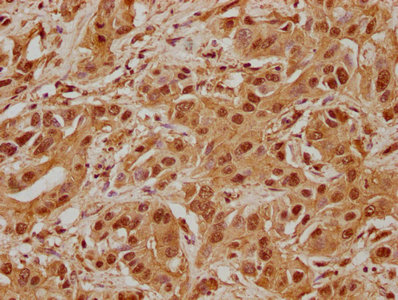
  • IHC image of CSB-PA836229NA01HU diluted at 1:100 and staining in paraffin-embedded human liver cancer performed on a Leica BondTM system. After dewaxing and hydration, antigen retrieval was mediated by high pressure in a citrate buffer (pH 6.0). Section was blocked with 10% normal goat serum 30min at RT. Then primary antibody (1% BSA) was incubated at 4°C overnight. The primary is detected by a biotinylated secondary antibody and visualized using an HRP conjugated SP system.

Customer Reviews and Q&A

 Customer Reviews

Target Background

Function(From Uniprot)
Adapter or scaffold protein which participates in the assembly of numerous protein complexes and is involved in several cellular processes such as cell fate determination, cytoskeletal organization, repression of gene transcription, mitosis, cell-cell adhesion, cell differentiation, proliferation and migration. Contributes to the linking and/or strengthening of epithelia cell-cell junctions in part by linking adhesive receptors to the actin cytoskeleton. May be involved in signal transduction from cell adhesion sites to the nucleus. Plays an important role in regulation of the kinase activity of AURKA for mitotic commitment. Also a component of the IL-1 signaling pathway modulating IL-1-induced NFKB1 activation by influencing the assembly and activity of the PRKCZ-SQSTM1-TRAF6 multiprotein signaling complex. Functions as an HDAC-dependent corepressor for a subset of GFI1 target genes. Acts as a transcriptional corepressor for SNAI1 and SNAI2/SLUG-dependent repression of E-cadherin transcription. Acts as a hypoxic regulator by bridging an association between the prolyl hydroxylases and VHL enabling efficient degradation of HIF1A. Positively regulates microRNA (miRNA)-mediated gene silencing. Negatively regulates the Hippo signaling pathway and antagonizes phosphorylation of YAP1.
Gene References into Functions
  1. High AJUBA level enhances cervical cancer cells. PMID:29126926
  2. Data show that AJUBA upregulated MMP10 and MMP13 expression in esophageal squamous cell carcinoma (ESCC). PMID:27172796
  3. Mechanistic investigations reveal that AJUBA specifically binds the FERM domain of JAK1 to dissociate JAK1 from the IFNgamma recepter, resulting in an inhibition of STAT1 phosporylation and concomitantly its nuclear translocation. Clinically, the level of AJUBA in CRC specimens is negatively correlated with the levels of IFIT2 and pSTAT1 PMID:27893714
  4. AJUBA is a LIM domain protein and contributes to the formation and stability of cadherin-mediated cell-cell adhesion. Loss of AJUBA enhances Prostate cancer cell migration and downregulation of AJUBA expression is observed in metastatic Prostate cancer. PMID:28422308
  5. Mutations of the LIM protein AJUBA mediate sensitivity of head and neck squamous cell carcinomas to treatment with PLK1 inhibitors. PMID:28126323
  6. mitotic phosphorylation of Ajuba is sufficient to promote cell proliferation and anchorage-independent growth in vitro and tumorigenesis in vivo PMID:27226586
  7. The results in this study uncovered that JUB was a regulator involved in proliferation of glioma cells, and it could be used as a potential therapeutic target for glioma. PMID:26406867
  8. AJUBA negatively regulates YAP activity through the LATS family, and inactivation of AJUBA is a novel key mechanism in malignant mesothelioma cell proliferation PMID:24336325
  9. the LIM protein JUB serves as a tumor-promoting gene in colorectal cancer by promoting epithelial-mesenchymal transition, a critical process of metastasis. PMID:24673742
  10. The LIM domain of Ajuba can competitively bind to the N-terminal of Aurora-A, and inhibited the interaction between N-terminal and C-terminal of Aurora A. PMID:24680704
  11. A Rac-PAK1-Ajuba feedback loop integrates spatiotemporal signaling with actin remodeling at cell-cell contacts and stabilizes preassembled cadherin complexes. PMID:22105346
  12. Ajuba contains functional nuclear-receptor interacting motifs and selectively interacts with retinoic acid receptors and rexinoid receptor subtypes. PMID:20133701
  13. Ajuba contributes to the bridging of the cadherin adhesive complexes to the actin cytoskeleton and as such contribute to the formation or strengthening of cadherin-mediated cell-cell adhesion. PMID:12417594
  14. in addition to its effects upon Rac activity, Ajuba can also influence cell migration through regulation of PI(4,5)P2 synthesis through direct activation of PIPKIalpha enzyme activity PMID:15870270
  15. Ajuba is a new cytosolic component of the IL-1 signaling pathway modulating IL-1-induced NF-kappaB activation by influencing the assembly and activity of the aPKC/p62/TRAF6 multiprotein signaling complex PMID:15870274
  16. Ajuba promoted GSK-3beta-mediated phosphorylation of beta-catenin by reinforcing the association between beta-catenin and GSK-3beta. PMID:17621269
  17. Ajuba is a microtubule-associated protein that collaborates with Aurora B and BUBR1 at the metaphase-anaphase transition and this may be important to ensure proper chromosome segregation. PMID:18710370
  18. Ajuba is utilized as a corepressor selectively on Gfi1 target genes PMID:18805794

Show More

Hide All

Subcellular Location
Cytoplasm, cytoskeleton. Cell membrane. Cell junction. Nucleus. Cytoplasm, cytoskeleton, microtubule organizing center, centrosome. Cytoplasm, P-body. Note=Shuttles between the cytoplasm and the nucleus. Localizes on centrosomes during G2-M phase. Preferentially co- localizes with cadherin-adhesive complexes at sites of cell-cell contacts. Colocalizes with GFI1 in the nucleus.
Protein Families
Zyxin/ajuba family
Database Links

HGNC: 20250

UNIGENE: Hs.655832

KEGG: hsa:84962

STRING: 9606.ENSP00000262713

OMIM: 609066

icon of phone
Call us
301-363-4651 (Available 9 a.m. to 5 p.m. CST from Monday to Friday)

icon of address
Address
No. 269, Shendun 5th Road, Donghu Hi-Tech Development Area, Hubei Province, 430206, P.R.China
icon of social media
Join us with

Subscribe newsletter

Leave a message

* To protect against spam, please pass the CAPTCHA test below.
CAPTCHA verification
© 2007-2025 CUSABIO TECHNOLOGY LLC All rights reserved. 鄂ICP备15011166号-1
Select 0 Products