Upon receipt, store at -20°C or -80°C. Avoid repeated freeze.
Lead Time
Basically, we can dispatch the products out in 1-3 working days after receiving your orders. Delivery time maybe differs from different purchasing way or location, please kindly consult your local distributors for specific delivery time.
Note: All of our proteins are default shipped with normal blue ice packs, if you request to ship with dry ice, please communicate with us in advance and extra fees will be charged.
Usage
For Research Use Only. Not for use in diagnostic or therapeutic procedures.
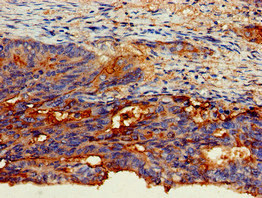
Immunohistochemistry of paraffin-embedded human colon cancer using CSB-PA005166LA01HU at dilution of 1:100
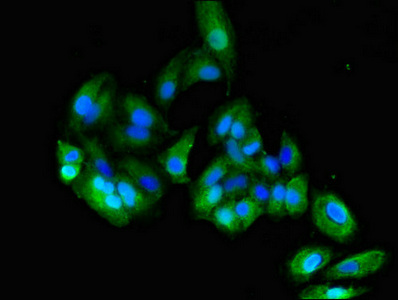
Immunofluorescent analysis of HepG2 cells using CSB-PA005166LA01HU at dilution of 1:100 and Alexa Fluor 488-congugated AffiniPure Goat Anti-Rabbit IgG(H+L)
Cell surface glycoprotein that plays a role in cell adhesion and tumor progression. Intercellular adhesion occurs in a calcium- and fibronectin-independent manner. Mediates homophilic and heterophilic cell adhesion with other carcinoembryonic antigen-related cell adhesion molecules, such as CEACAM5 and CEACAM8. Heterophilic interaction with CEACAM8 occurs in activated neutrophils. Plays a role in neutrophil adhesion to cytokine-activated endothelial cells. Plays a role as an oncogene by promoting tumor progression; positively regulates cell migration, cell adhesion to endothelial cells and cell invasion. Also involved in the metastatic cascade process by inducing gain resistance to anoikis of pancreatic adenocarcinoma and colorectal carcinoma cells.
Gene References into Functions
CEACAM6 promoted oral squamous cell carcinoma cell invasion, migration, cytoskeletal rearrangement, and metastasis via interaction with EGFR and enhancing it activation.PMID:28892050
Studies provide evidence that dysregulated overexpression of CEACAM6 plays a role in several of the hallmarks of cancer, including uncontrolled proliferation, anoikis resistance, immune evasion, invasion and metastasis. [review]PMID:29110374
Helicobacter pylori HopQ binds the amino-terminal IgV-like domain of human CEACAM1, CEACAM3, CEACAM5 or CEACAM6 proteins, thereby enabling translocation of the major pathogenicity factor CagA into host cells.PMID:27748756
Here, the authors identify members of the carcinoembryonic antigen-related cell adhesion molecule (CEACAM) family as receptors of Helicobacter pylori and show that HopQ is the surface-exposed adhesin that specifically binds human CEACAM1, CEACAM3, CEACAM5 and CEACAM6.PMID:27748768
CD66c (KOR-SA3544) antigen expression of leukemic blasts in pediatric acute myeloid leukemia with TLS/FUS-ERG fusion transcriptPMID:28766906
Data suggest that the expression of these TSPAN8, LGALS4, COL1A2 and CEACAM6 in the whole blood may be useful in the detection of colorectal cancer (CRC).PMID:26993598
expression is increased in severe asthma and primarily associated with airway epithelial cells and tissue neutrophilsPMID:28275137
a 7-gene signature was identified which correctly predicted the primary prefibrotic myelofibrosis group with a sensitivity of 100% and a specificity of 89%. The 7 genes included MPO, CEACAM8, CRISP3, MS4A3, CEACAM6, HEMGN, and MMP8PMID:27579896
In enterocytic C2BBe1 cells, Candida albicans caused a transient tyrosine phosphorylation of CEACAM1 and induced higher expression of membrane-bound CEACAM1 and soluble CEACAM6.PMID:28292985
Monoclonal Antibody 1B5A5 Against CEACAM6PMID:27328063
western blot analysis results indicated that the 1B5A5 epitope is located within an amino-terminal domain of CEACAM6. These results raised the possibility that our approach could lead to discovery of novel biomarkers for the early stage of cancers in a relatively short period of time.PMID:27172290
show the upregulation of the tumor-associated antigens CEACAM5/6 by trans-signaling of the pro-inflammatory cytokine IL-6PMID:26673628
Biliary CEACAM6 can identify patients with extrahepatic cholangiocarcinoma with a high degree of sensitivity and should be investigated further as a potential screening tool.PMID:26974538
Data suggest ways in which carcinoembryonic antigen-related cell adhesion molecules CEACAM6 and CEACAM8 regulate the biological functions of one another.PMID:26483485
CEACAM6 protein and mRNA were increased ~4-fold in lungs from infants with chronic lung disease as compared with controls.PMID:26374831
vaccination with recombinant attenuated Salmonella harboring the CEACAM6 and 4-1BBL gene efficiently increased the number of CD3+CD8+ TIL and NK cells, decreased the number of FOXP3 cells and inhibited the development of DMH-induced colorectal cancerPMID:25872647
CEACAM6 increased the levels of phosphorylated AKT, which is involved in the progression of a variety of human tumors.PMID:25398131
Data show that carcinoembryonic antigen-related cell adhesion molecule 6 (CEACAM6) and forkhead box P3 (FOXP3) are associated with the malignant degree of pancreatic cancer.PMID:26271985
Data indicate that carcinoembryonic antigen-related cell adhesion molecule 6 (CEACAM6) promotes angiogenesis in gastric cancer via focal adhesion kinase FAK signaling.PMID:25703140
Results show that pancreatic cancer patients with CEACAM 1, 5 and 6 expression showed a significantly shortened overall survival and elevated serum values are correlated with distant metastasis suggesting a role in epithelial-mesenchymal transition.PMID:25409014
CEACAM6 may be a valuable biomarker screening for gastric tumor and novel predictor for patients in advanced stages of gastric cancerPMID:25299082
results suggested that CEACAM6 functions as an oncoprotein in gastric cancer and may be an important metastatic biomarker and therapeutic targetPMID:24492534
CEACAM6 expression was expressed in different molecular subtypes of breast cancer. Among different subtypes, the highest expression was found with HER2 positive cancers.PMID:24186057
High carcinoembryonic cell adhesion molecule 6 expression is associated with malignant biliary stenoses.PMID:23806607
our findings identified CEACAM6, which is regulated by miR-29a/b/c, as an important positive regulator of EMT in pancreatic cancerPMID:23857344
CD66c expression appears useful only as a predictor of the Ph in adult patients (not in pediatric cases).PMID:24014076
Data indicate that CD66c is frequently expressed in CRLF2-positive as well as hypodiploid cases.PMID:24231528
these findings show that PDEF-CEACAM6 is a highly active oncogenic axis in breast cancerPMID:23592399
CEACAM-6 plays an important role in the regulation of CD8+ T-cell responses against multiple myeloma.PMID:23603913
CEACAM6 is significantly upregulated in colon cancer tissues and is closely associated with poor prognosis.PMID:22975528
The expression of CD66c was significantly higher in colorectal cancer specimens than in normal colon.PMID:23027178
CEACAM6 is focally overexpressed in a large fraction of human HNSCCs in situ. over-expression of CEACAM6 increases tumour growth and tumour initiating activity by suppressing PI3K/AKT-dependent apoptosis of HNSCC in a xenotransplant model of HNSCC.PMID:23021083
High CEACAM6 expresssion is associated with inflammatory bowel disease.PMID:21994005
a novel role for NA in enhancing host cell survival by activating the Src/Akt signaling axis via an interaction with carcinoembryonic antigen-related cell adhesion molecule 6/cluster of differentiation 66c (C6).PMID:22396546
The authors show that the expression of CEACAM1 and CEACAM6 potentiate CEACAM3-dependent responses of neutrophils, exposing a cooperative role for this family of proteins during neisserial infection of neutrophils.PMID:22064717
CEACAM6 is expressed by alveolar and airway epithelial cells of human lung and is secreted into lung-lining fluid, where fully glycosylated protein binds to surfactant.PMID:22037359
Despite its important role in bacterial attachment in ileal CD, no role was detected for CEACAM6 variants in IBD susceptibility or regarding an ileal CD phenotypePMID:21559399
The highly elevated gene expression of CEACAM6 and CEACAM8 in primary myelofibrosis can serve as molecular markers of myelofibrotic transformation.PMID:21470677
High serum CEACAM6 is associated with gastric cancer.PMID:21618249
CEACAM6 and a regulatory element near the 3' end of CEACAM3 are associated with cystic fibrosis disease severity and intrapair discordancePMID:20047061
Positivity for both leukemia-associated antigens CD66c and CD25 in combination can predict the presence of BCR/ABL rearrangement in pre-B cell acute lymphoblastic leukemiaPMID:20063526
Overexpression of CEACAM6 disrupts tissue architecture and blocks colonocyte differentiationPMID:11896570
CEACAM6 subdomains involved in intercellular adhesion activity and subdomains involved in inhibition of cell differentation are identified and their respective activities are independently blocked.PMID:12571231
CEACAM6 gene silencing reversed the acquired anoikis resistance of tumor cell lines and inhibited in vivo metastatic abilityPMID:14724575
overexpression among human malignancies, immunological targeting of this tumor antigen may have therapeutic applicabilityPMID:15081416
the results show that recognition of CEA and CEACAM6, but not CEACAM1, is accompanied by tight attachment to bacteria of cell surface microvilli-like extensionsPMID:15130118
CEACAM6 is an important determinant of pancreatic adenocarcinoma malignant cellular behaviorPMID:15208677
Levels of CEACAM6 expression can modulate pancreatic adenocarcinoma cellular invasiveness in a c-Src-dependent mannerPMID:15316565
CD66c is regulated in a manner distinct from other myeloid antigens in childhood lymphoblastic leukemiaPMID:15826304
Data show that variants of Neisseria gonorrhoeae that bind to human carcinoembryonic antigen-related cell adhesion molecules (CEACAMs) 1 and 6 failed to induce detachment and, instead, promoted enhanced host cell adhesion to the ECM.PMID:16115956