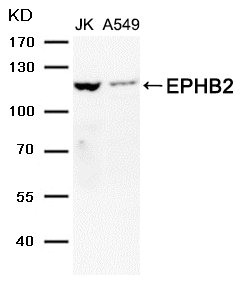
Peptide sequence around aa.896~900 (L-S-S-G-I) derived Human from EPHB2.
Immunogen Species
Homo sapiens (Human)
Purification Method
Antibodies were produced by immunizing rabbits with synthetic peptide and KLH conjugates. Antibodies were purified by affinity-chromatography using epitope-specific peptide.
Concentration
It differs from different batches. Please contact us to confirm it.
Tested Applications
ELISA,WB
Storage
Upon receipt, store at -20°C or -80°C. Avoid repeated freeze.
Lead Time
Basically, we can dispatch the products out in 1-3 working days after receiving your orders. Delivery time maybe differs from different purchasing way or location, please kindly consult your local distributors for specific delivery time.
Note: All of our proteins are default shipped with normal blue ice packs, if you request to ship with dry ice, please communicate with us in advance and extra fees will be charged.
Usage
For Research Use Only. Not for use in diagnostic or therapeutic procedures.
Receptor tyrosine kinase which binds promiscuously transmembrane ephrin-B family ligands residing on adjacent cells, leading to contact-dependent bidirectional signaling into neighboring cells. The signaling pathway downstream of the receptor is referred to as forward signaling while the signaling pathway downstream of the ephrin ligand is referred to as reverse signaling. Functions in axon guidance during development. Involved in the guidance of commissural axons, that form a major interhemispheric connection between the 2 temporal lobes of the cerebral cortex. Also involved in guidance of contralateral inner ear efferent growth cones at the midline and of retinal ganglion cell axons to the optic disk. In addition to axon guidance, also regulates dendritic spines development and maturation and stimulates the formation of excitatory synapses. Upon activation by EFNB1, abolishes the ARHGEF15-mediated negative regulation on excitatory synapse formation. Controls other aspects of development including angiogenesis, palate development and in inner ear development through regulation of endolymph production. Forward and reverse signaling through the EFNB2/EPHB2 complex regulate movement and adhesion of cells that tubularize the urethra and septate the cloaca. May function as a tumor suppressor. May be involved in the regulation of platelet activation and blood coagulation.
Gene References into Functions
These findings suggested that miR-204 might serve as a tumor suppressor in the development of cervical cancer by directly targeting EphB2.PMID:28800788
EphB2 signaling-mediated Sirt3 expression reduces MSC senescence by maintaining mitochondrial reactive oxygen species homeostasis.PMID:28687409
This is the first study to link SLC1A3 and EPHB2 to clinically relevant vertebral osteoporosis phenotypes.PMID:27476799
Data show that EPHB2 predicted poor breast cancer survival and EPHB2 protein expression has also prognostic value depending on cell localization.PMID:26870995
showed that patients with SSc or SLE have AAb against EphB2, a protein involved in angiogenesis, and THEX1, a 3'-5' exoribonuclease involved in histone mRNA degradation. We have further identified a peptide from EphB2 as a specific and sensitive tool for SLE diagnosisPMID:27617966
show that expression of EPHB2 and SNAIL1 - an inducer of epithelial-mesenchymal transition (EMT) - is anti-correlated in colorectal cancer cell lines and tumorsPMID:27504909
Tiam2/Rac are key components of EphB2 trans-endocytosis and are important for cell repulsion.PMID:27597758
High expression of junctional adhesion molecule-A and EphB2 can predict poor overall survival and high mortality rate, and EphB2 is an independent prognostic biomarker in lung adenocarcinoma patients.PMID:28231727
Data show that activation of EphB2 receptor kinase arrests tau protein hyperphosphorylation through phosphatidylinositol 3-kinase (PI3K)/Akt protein-mediated glycogen synthase kinase-3beta (GSK-3beta) inhibition.PMID:26119563
Expression of the Receptor Tyrosine Kinase EphB2 on Dendritic Cells Is Modulated by Toll-Like Receptor Ligation but Is Not Required for T Cell ActivationPMID:26407069
Myosin 1 functions as an effector of EphB2/ephrinB signaling, controls cell morphology, and thereby cell repulsion.PMID:26195670
EphB2 activation is required for ependymoma development as well as it inhibits differentiation and promotes proliferation of the transformed cell.PMID:25801123
The results show an intricate interplay between p53 and TGF-beta3 whereby p53 inhibits the TGF-beta3-induced expression of genes, e.g., EPHB2, to impede tumor cell invasion and migrationPMID:25257729
loss of EphB2 and gain of EphB4 expression represents an inflection point in the development, growth and possibly progression of TCC.PMID:25148033
knockdown impairs monocyte transmigration through the endotheliumPMID:24522257
the upregulation of EphB2 receptors and its specific ligands leads to cholangiocarcinoma metastasis.PMID:25012246
Serrated colorectal carcinoma as proposed to arise from serrated adenoma is characterized by down regulation of EphB2.PMID:24612059
Comparative crystalisation analysis of the human EphB family kinases has yielded new crystal forms of the human EphB2 and EphB4 catalytic domains.PMID:24677421
EphB2 was involved in human naive B cell activation through Src-p65 and Notch1 signaling pathways and could be regulated by miR-185.PMID:24803541
Overexpression of EphB2 is associated with glioma.PMID:23835497
EphB2 plays an important role in cervical cancer progression by orchestrating an epithelial-mesenchymal transition program through R-Ras activation.PMID:24439224
A mechanism involving a triple role for EphB2 in breast cancer progression, whereby it regulates apoptosis, autophagy, and invasion.PMID:24211352
overexpression of Ephrin B2 receptor is associated with malignant mesothelioma.PMID:23887168
Mutation of EPHB2 is frequent in colorectal tumors with microsatellite instability.PMID:24222164
Marrow stromal cell subpopulations express EphB2 engrafted in the fetal intestinal epithelium when xenografted into sheepPMID:23413357
High ephrin-B1 expression is associated with medulloblastoma.PMID:22723427
PTPN14 has a role in angiogenesis and/or arteriovenous fate, acting via EphrinB2 and ACVRL1/activin receptor-like kinase 1PMID:22233626
Data indicated for the first time that EphrinB2 and EphB4 expressions increase according to the histopathological grade and KPS score of glioma, and their expression levels are related to the progression-free survival of glioblastoma patients.PMID:22374425
Define the transcriptional targets of the reverse signaling by EphB2 acting exclusively as a ligand in epidermal keratinocyte differentiation.PMID:21809346
High Eph-B2 is associated with Waldenstrom's macroglobulinemia.PMID:22010211
EphB2 is an ephrin receptor and is up-regulated in invasive tumors but its role needs to be confirmed in further cases of Wilms tumors.PMID:21387540
EPHB2 interacts with EPHB6 in breast tumor cell linesPMID:21737611
data suggest that genetic variation at the EphB2 locus may increase risk of sporadic prostate cancer risk in African American men.PMID:21603658
Mutation in EphB2 gene is associated with colorectal adenocarcinomaPMID:21161727
at least in the context of pancreatic carcinoma CFPAC-1 cells, EphB2 plays a tumor suppressor role in cell proliferation and apoptosisPMID:21292437
Even a moderate level of EphB2 expression has effects on tumour cells which results in reduced migration and invasiveness and slows the growth of colonic tumour implants in an in vivo model.PMID:20339854
The MAPK pathway is important in the pro-death action of EphB2, through ERK1/2 phosphorylation and inhibition of this pathway using PD98059 counters EphB2-driven cell death.PMID:20046096
RYK, a catalytically inactive receptor tyrosine kinase, associates with EphB2 and EphB3 but does not interact with AF-6.PMID:11956217
role of extracellular signal-regulated kinase (ERK) during the differentiation of human monoblastic U937 cells stimulated by granulocyte-macrophage colony-stimulating factor (GM-CSF) and tumor necrosis factor (TNF)PMID:12063024
liganded to EFNB1 and EFNB2, expresssed in gastric cancerPMID:12136247
Glioma migration and invasion are promoted by activation of EphB2 or inhibited by blocking EphB2. Dysregulation of EphB2 expression or function may underlie glioma invasion.PMID:15126357
our findings suggest that mutational inactivation of EPHB2 may be important in the progression and metastasis of prostate cancer.PMID:15300251
loss of EphB expression represents a critical step in colorectal cancer progressionPMID:15973414
Deregulated EphB2 expression may play a role in several cancer types with loss of EphB2 expression serving as an indicator of the possible pathogenetic role of EphB2 signaling in the maintenance of tissue architecture of colon epithelium.PMID:16166419
progressive loss of EphB2 expression seen in each critical step of colon carcinogenesis, including the onset of invasion, dedifferentiation and metastasis which are paralleled by adverse patient outcomePMID:16272170
These results demonstrate that the MAPK ERK signaling pathway contributes to the p53-independent antiproliferative functions of p14ARF. Furthermore, they identify a new mechanism by which phosphorylation at serine 216 participates to Cdc25C inactivation.PMID:16582626
analysis of germline EPHB2 alterations in patients with colorectal tumorsPMID:16740153
High EPHB2 mutation rate is associated with gastric tumors with microsatellite instabilityPMID:16819508
novel link between EphB forward signaling and SDF-1-induced signaling demonstrates a mechanism for cooperative regulation of endothelial cell movement.PMID:16840724
Show
More
Hide
All
Subcellular Location
Cell membrane; Single-pass type I membrane protein. Cell projection, axon. Cell projection, dendrite.
Protein Families
Protein kinase superfamily, Tyr protein kinase family, Ephrin receptor subfamily
Tissue Specificity
Brain, heart, lung, kidney, placenta, pancreas, liver and skeletal muscle. Preferentially expressed in fetal brain.