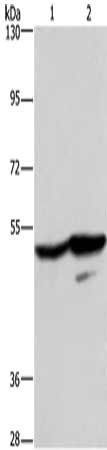
It differs from different batches. Please contact us to confirm it.
Buffer
-20°C, pH7.4 PBS, 0.05% NaN3, 40% Glycerol
Tested Applications
ELISA,WB
Storage
Upon receipt, store at -20°C or -80°C. Avoid repeated freeze.
Lead Time
Basically, we can dispatch the products out in 1-3 working days after receiving your orders. Delivery time maybe differs from different purchasing way or location, please kindly consult your local distributors for specific delivery time.
Note: All of our proteins are default shipped with normal blue ice packs, if you request to ship with dry ice, please communicate with us in advance and extra fees will be charged.
Usage
For Research Use Only. Not for use in diagnostic or therapeutic procedures.
Zn(2+) acts as an agonist. This receptor mediates its action by association with G proteins that activate a phosphatidylinositol-calcium second messenger system. Its effect is mediated mainly through G(q)-alpha and G(12)/G(13) proteins. Involved in regulation of body weight, gastrointestinal mobility, hormone secretion and cell death.
Gene References into Functions
data indicate that Zn(2+) acting via ZnR/GPR39 has a direct role in controlling Cl(-) absorption via upregulation of basolateral KCC1 in the colon. Moreover, colonocytic ZnR/GPR39 and KCC1 reduce water loss during diarrhea and may therefore serve as effective drug targets.PMID:28093242
G protein-coupled receptor 39 (ZnR/GPR39) was shown to regulate the activity of ion transport mechanisms that are essential for the physiological function of epithelial and neuronal cells [Review].PMID:29389900
Data suggest that expression of GPR39 undergoes Rho kinase-dependent desensitization following activation by zinc.PMID:28619258
This study demonstrated that zinc upregulates PKCzeta by activating GPR39 to enhance the abundance of ZO-1, thereby improving epithelial integrity in S. typhimurium-infected Caco-2 cells.PMID:28515165
obestatin/GPR39 system in the pathogenesis and/or clinical outcome of human gastric adenocarcinomas and highlight the potential usefulness of GPR39 as a prognostic marker in gastric cancer.PMID:26716511
Chronic administration of many antidepressants induces GPR39 up-regulation, which suggests that the Zn(2+)-sensing receptor may be considered as a new target for drug development in the field of depression.PMID:25490458
Taken together, our results provided a novel regulatory mechanism for GPR39-1b in NTRS1 signaling.PMID:24512471
ZnR/GPR39-dependent expression of tight junctional proteins, thereby leading to formation of a sealed intestinal epithelial barrier.PMID:24967969
Data suggests alterations (down-regulation) of the GPR39 receptor and involvement of CREB-BDNF pathway, possibly triggered by GPR39, as a new pathomechanism of depressionPMID:24333148
Zn(2+) -dependent activation of ZnR/GPR39 also enhances the expression of the Ca(2+) -binding protein S100A4 that is linked to invasion of prostate cancer cells.PMID:24264723
GPR39 was present in thyroid autoimmune disease, non-toxic nodular goiter and toxic nodular goiter at band p51(kDa).PMID:23485550
ZnR/GPR39 is tuned to sense physiologically relevant changes in extracellular pH that regulate ZnR-dependent signaling and ion transport activityPMID:22879599
GPR39 activation increased the expression of the anti-apoptotic protein clusterin in butyrate-treated cells. GPR39 mediates Zn2+-dependent cell growth.PMID:22545109
GPR39 plays an important tumorigenic role in the development and progression of esophageal squamous cell carcinoma.PMID:21352519
extracellular Zn(2+), either applied or released following injury, activates ZnR/GPR39 to promote signaling leading to epithelial repairPMID:20522546
Data show that Phe-V:13 can serve as an aromatic lock for the proposed active conformation of the Trp-VI:13 rotameric switch, being involved in the global movement of TM-V and TM-VI in 7TM receptor activation.PMID:19920139
GPR39 is probably not the obestatin receptorPMID:16959833
could activate GPR39 by high concentrations of Zn(2+), demonstrating cell surface expression of a functional receptor that could elicit a Ca(2+) response.PMID:17054911
GPR39 functions as a Gq-coupled Zn2+-sensing receptorPMID:17885920
GPR39 protects from cell death by increasing secretion of pigment epithelium-derived growth factorPMID:18180304
It is proposed that Zn2+ acts as an agonist for GPR39, not in the classical manner by directly stabilizing an active conformation of the transmembrane domain, but instead by binding to His17 and His19 in the extracellular domain.PMID:18588883
Show
More
Hide
All
Subcellular Location
Cell membrane; Multi-pass membrane protein.
Protein Families
G-protein coupled receptor 1 family
Tissue Specificity
Expressed in many tissues, including the stomach, intestine and hypothalamus.