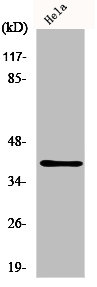
Synthesized peptide derived from the Internal region of Human P2Y4.
Immunogen Species
Homo sapiens (Human)
Conjugate
Non-conjugated
Isotype
IgG
Purification Method
The antibody was affinity-purified from rabbit antiserum by affinity-chromatography using epitope-specific immunogen.
Concentration
It differs from different batches. Please contact us to confirm it.
Buffer
Liquid in PBS containing 50% glycerol, 0.5% BSA and 0.02% sodium azide.
Tested Applications
WB, IF, ELISA
Storage
Upon receipt, store at -20°C or -80°C. Avoid repeated freeze.
Lead Time
Basically, we can dispatch the products out in 1-3 working days after receiving your orders. Delivery time maybe differs from different purchasing way or location, please kindly consult your local distributors for specific delivery time.
Note: All of our proteins are default shipped with normal blue ice packs, if you request to ship with dry ice, please communicate with us in advance and extra fees will be charged.
Usage
For Research Use Only. Not for use in diagnostic or therapeutic procedures.
Receptor for UTP and UDP coupled to G-proteins that activate a phosphatidylinositol-calcium second messenger system. Not activated by ATP or ADP.
Gene References into Functions
reflected in the immunoblotting data P2RY4 receptors were detected at higher levels of expression in patient with cortical dysplasia with intractable epilepsy.PMID:25003238
P2Y4 receptors are expressed in intracellular vesicles and sarcolemma of skeletal muscle fibers.PMID:22052557
show that P2 receptors and protein kinases are also involved in regulating injury-induced expression and the release of TSP-1 in injured astrocytesPMID:22776902
Nucleotide P2Y4 receptor binding is arrested in post-Golgi trafficking by type I transmembrane proteins p23 and p24A.PMID:21219331
Activation of the human P2Y(4) receptor expressed in 1321N1 cells by UTP did not elicit this protective effect, although both receptors were coupled to phospholipase C.PMID:12623123
second extracellular loop and the NH(2) terminus form a functional motif that plays a key role in determining whether ATP functions as an agonist or antagonist at mammalian P2Y(4) receptorsPMID:14670966
Taken together, our data indicate that the high expression and activation of the P2Y4 receptor participates in the neuronal differentiation and commitment to death of SH-SY5Y cells.PMID:15649700