Recombinant Human Ras GTPase-activating protein 1 (RASA1), partial

Code: CSB-EP019346HU
Size:
20ug
20ug100ug1mg(1mg*1 or 500ug*2)
US$306
Quantity:
Express system: E.coli
Species: Homo sapiens (Human)
Tag Info: N-terminal 10xHis-tagged and C-terminal Myc-tagged
For inquiries on large quantities or another requirements
Send an Inquiry
Start an on-line Chat
Online ordering is currently available for U.S. customers only. For orders outside the U.S., please kindly submit an inquiry or start a chat with us.

Product Details

Purity
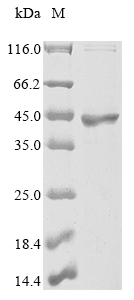
Greater than 85% as determined by SDS-PAGE.
Target Names
RASA1
Uniprot NO.
Research Area
Neuroscience
Species
Homo sapiens (Human)
Source
E.coli
Expression Region
714-1047aa
Target Protein Sequence
MEKIMPEEEYSEFKELILQKELHVVYALSHVCGQDRTLLASILLRIFLHEKLESLLLCTLNDREISMEDEATTLFRATTLASTLMEQYMKATATQFVHHALKDSILKIMESKQSCELSPSKLEKNEDVNTNLTHLLNILSELVEKIFMASEILPPTLRYIYGCLQKSVQHKWPTNTTMRTRVVSGFVFLRLICPAILNPRMFNIISDSPSPIAARTLILVAKSVQNLANLVEFGAKEPYMEGVNPFIKSNKHRMIMFLDELGNVPELPDTTEHSRTDLSRDLAALHEICVAHSDELRTLSNERGAQQHVLKKLLAITELLQQKQNQYTKTNDVR
Note: The complete sequence may include tag sequence, target protein sequence, linker sequence and extra sequence that is translated with the protein sequence for the purpose(s) of secretion, stability, solubility, etc.
If the exact amino acid sequence of this recombinant protein is critical to your application, please explicitly request the full and complete sequence of this protein before ordering.
Mol. Weight
45.6 kDa
Protein Length
Partial
Tag Info
N-terminal 10xHis-tagged and C-terminal Myc-tagged
The tag type will be determined during production process. If you have specified tag type, please tell us and we will develop the specified tag preferentially.
Form
Liquid or Lyophilized powder
Note: We will preferentially ship the format that we have in stock, however, if you have any special requirement for the format, please remark your requirement when placing the order, we will prepare according to your demand.
Buffer
If the delivery form is liquid, the default storage buffer is Tris/PBS-based buffer, 5%-50% glycerol. If the delivery form is lyophilized powder, the buffer before lyophilization is Tris/PBS-based buffer, 6% Trehalose.
Reconstitution
We recommend that this vial be briefly centrifuged prior to opening to bring the contents to the bottom. Please reconstitute protein in deionized sterile water to a concentration of 0.1-1.0 mg/mL.We recommend to add 5-50% of glycerol (final concentration) and aliquot for long-term storage at -20°C/-80°C. Our default final concentration of glycerol is 50%. Customers could use it as reference.
Storage
The shelf life is related to many factors, storage state, buffer ingredients, storage temperature and the stability of the protein itself. Generally, the shelf life of liquid form is 6 months at -20°C/-80°C. The shelf life of lyophilized form is 12 months at -20°C/-80°C.
Shelf Life
The shelf life is related to many factors, storage state, buffer ingredients, storage temperature and the stability of the protein itself.
Generally, the shelf life of liquid form is 6 months at -20°C/-80°C. The shelf life of lyophilized form is 12 months at -20°C/-80°C.
Lead Time
13-23 business days
Note: All of our proteins are default shipped with normal blue ice packs, if you request to ship with dry ice, please communicate with us in advance and extra fees will be charged.
Notes
Repeated freezing and thawing is not recommended. Store working aliquots at 4°C for up to one week.
Troubleshooting and FAQs
Datasheet & COA
Please contact us to get it.
Images
  • (Tris-Glycine gel) Discontinuous SDS-PAGE (reduced) with 5% enrichment gel and 15% separation gel.
Description

The production of this recombinant Human RASA1 protein is just like all recombinant proteins. The process involved transfecting Mammalian cell cells with DNA vector containing the template of recombinant DNA. The Mammalian cell cells containing the template were then cultured so that they could transcribe and translate the RASA1 protein. N-terminal 10xHis tag & C-terminal Myc tag was used in the process. The purity is 85% determined by SDS-PAGE.

RASA1 is a gene providing instructions for making a protein named Ras GTPase-activating protein 1 (also known as GAP, GTPase-activating protein, RasGAP, Ras p21 protein activator or p120GAP). RasGAP, an inhibitory regulator of the Ras-cyclic AMP pathway, is a multifunctional molecule involved in blood vessel morphogenesis, intracellular signal transduction, negative regulation of apoptotic process and cell adhesion, regulation of actin filament polymerization and regulation of RNA metabolic process.


Customer Reviews and Q&A

 Customer Reviews

Target Background

Function(From Uniprot)
Inhibitory regulator of the Ras-cyclic AMP pathway. Stimulates the GTPase of normal but not oncogenic Ras p21; this stimulation may be further increased in the presence of NCK1.
Gene References into Functions
  1. A somatic RASA1 mutation in addition to the germline RASA1 mutation, was detected within endothelial cells in capillary malformation-arteriovenous malformation. PMID:29024832
  2. RASA1 variants are rarely found in children with sporadic capillary malformations of lower limbs without capillary malformation-arteriovenous malformation syndrome. PMID:29110021
  3. RASA1 mutations are associated melanoma tumorigenesis. PMID:26993606
  4. MicroRNA-21 reduces RASA1 expression in cervical cancer cell lines and promotes cervical cancer cell migration via RASA1. Furthermore, Ras-induced epithelial-mesenchymal transition contributes to miR-21/RASA1 axis promoting cervical cancer cell migration. PMID:27101583
  5. These results and the extreme variable expressivity support the hypothesis that somatic "second hits" are required for the development of vascular anomalies associated with CM-AVM syndrome. In addition, the phenotypes of the affected individuals further clarify that lymphatic manifestations are also part of the phenotypic spectrum of RASA1-related disorders. PMID:26969842
  6. results indicate that, mTOR, Bad, or Survivin are not required for p120 RasGAP fragment N to protect cells from cell death; conclude that downstream targets of Akt other than mTORC1, Bad, or survivin mediate fragment N-induced protection or that several Akt effectors can compensate for each other to induce the pro-survival fragment N-dependent responses PMID:23826368
  7. The interaction between RASA1 and EPHB4 is an indication of the major cause of capillary malformation with arteriovenous malformation. PMID:28687708
  8. Low RASA1 expression is associated with Triple-Negative Breast Cancer. PMID:28108518
  9. QKI-5 stabilized RASA1 mRNA via directly binding to the QKI response element region of RASA1, which in turn prevented the activation of the Ras-MAPK signaling pathway, suppressed cellular proliferation and induced cell cycle arrest. PMID:27767378
  10. Data show that patients with low level of Ras GTPase-activating protein 1 (RASA1) expression correlated with a significantly poorer survival compared to those with high level of RASA1 expression. PMID:28179330
  11. Results show that oncogenic KRAS can activate Rho through miR-31-mediated regulation of RASA1 indicating miR-31 acts as a KRAS effector to modulate invasion and migration in pancreatic cancer. PMID:26747707
  12. Data suggest that, in response to netrin-1/netrin receptor (DCC) signaling, p120RasGAP is recruited to growth cones and supports axon outgrowth; p120RasGAP Src homology 2 domains exhibit scaffolding properties sufficient to support axon outgrowth. PMID:26710849
  13. Maternal and fetal capillary malformation-arteriovenous malformation due to a novel RASA1 mutation presenting with prenatal non-immune hydrops fetalis have been found. PMID:26096958
  14. This is the second largest study on isolated, non-syndromic Port-wine stain; data suggest that GNAQ is the main genetic determinant in this condition. Moreover, isolated port-wine stains are distinct from capillary malformations seen in RASA1 disorders. PMID:26192947
  15. Data showed that hypoxia regulated the expression of miR-182 and RASA1 to promote HCC angiogenesis. PMID:26126858
  16. p120RasGAP shields Akt from deactivating phosphatases in FGF1 signaling, but loses this ability once cleaved by caspase-3. PMID:26109071
  17. Capillary malformation-arteriovenous malformation syndrome (CM-AVM) is an autosomal dominant disorder caused by RASA1 mutations. PMID:25040287
  18. Multifocal, small, round-to-oval, pinkish-to-red cutaneous capillary malformations are seen in more than 90% of people with RASA1 mutations. PMID:23829194
  19. miR-21 promotes malignant behaviors of colon cancer cells by regulating RASA1 expression via RAS pathways. PMID:25663768
  20. The individual contribution of each Akt isoform in p120 RasGAP fragment N-mediated cell protection against Fas ligand induced cell death, was investigated. PMID:25246356
  21. Low RASA1 expression is associated with colorectal cancer. PMID:25867276
  22. Results show that report that RasGAP associates to PDGFRbeta and prevents its direct activation. This underlying mechanism raises the possibility that PDGFRbeta-mediated diseases involve indirect activation of PDGFRbeta. PMID:25733681
  23. RASA1 expression is associated with breast cancer progression and poor survival and diseasefree survival of patients. PMID:25394563
  24. Antisense-mediated knockdown (anti-miR) revealed that miR-206/21 coordinately promote RAS-ERK signaling and the corresponding cell phenotypes by inhibiting translation of the pathway suppressors RASA1 and SPRED1. PMID:25202123
  25. A ubiquitous binding partner of p190RhoGAP, p120RasGAP (RasGAP), is expressed in much lower levels in DKO4 cells compared to DLD1, and this expression is regulated by KRAS. PMID:24465899
  26. The results of the present study indicate that P110, in combination with chemotherapeutics, is likely to represent a potential therapeutic strategy for cancer. PMID:23447049
  27. The novel findings of this study shed light on the molecular mechanisms underlying the DLC1 inhibitory effects of p120 and suggest a functional cross-talk between Ras and Rho proteins at the level of regulatory proteins. PMID:24443565
  28. RASA1 mutations specifically cause capillary malformation-arteriovenous malformation. PMID:24038909
  29. These results indicate that stress-activated caspase-3 might contribute to the suppression of metastasis through the generation of fragment N2( RasGAP PMID:24347041
  30. our study reveals mir-182 suppresses cell proliferation in vivo. RASA1 is related to cell apoptosis. We further show that mir-182 downregulates RASA1 PMID:24600991
  31. RASA1 mutation is responsible for the aberrant lymphatic architecture and functional abnormalities, as visualized in the PKWS subject and in the animal model. PMID:23650393
  32. MicroRNA-31 activates the RAS pathway and functions as an oncogenic MicroRNA by repressing RAS p21 GTPase activating protein 1 (RASA1) PMID:23322774
  33. 14-3-3 negatively regulates the RGC downstream of the PI3-kinase/Akt signaling pathway PMID:23386617
  34. capillary malformation-arteriovenous malformation syndrome; study reports a family with a novel mutation in the RASA1 gene - a truncating mutation in exon 11 of RASA1 (Q503X) PMID:23158644
  35. Ras and GTPase-activating protein (GAP) drive GTP into a precatalytic state as revealed by combining FTIR and biomolecular simulations PMID:22949691
  36. multifocal capillary malformations is the key clinical finding to suggest a RASA1 mutation PMID:22200646
  37. An update of the associated phenotype variability in a family with hereditary capillary malformations caused by a mutation in the RASA1 gene. PMID:22342634
  38. arguments against G3BP1 being a genuine RasGAP-binding partner PMID:22205990
  39. Cell adhesion to the substrate is necessary for RasGAP to bind Nck1. Cell detachment makes RasGAP incapable of associating with Nck1 and decreases RasGAP activity. PMID:21664272
  40. The results assign an unexpected role for p120RasGAP in the regulation of integrin traffic in cancer cells and reveal a new concept of competitive binding of Rab GTPases and GAP proteins to receptors as a regulatory mechanism in trafficking. PMID:21768288
  41. Nck1 activates RasGAP by direct binding in the substrate-attached but not in the suspended cells. PMID:21664272
  42. An important role is revealed for p120 RasGAP (RASA1) as a transgenic regulator of CD4+CD8+ double-positive cell survival and positive selection in the thymus as well as naive T cell survival in the periphery. PMID:21646295
  43. Ras mutation cooperates with beta-catenin activation to drive bladder tumourigenesis. PMID:21368895
  44. A novel synonymous mutation (c.1229 G > A [p.K420K]) of RASA1 was identified in a Chinese population with sporadic Sturge-Weber syndrome PMID:20821215
  45. Sema4D/Plexin-B1 promotes the dephosphorylation and activation of PTEN through the R-Ras GAP activity, inducing growth cone collapse. PMID:20610402
  46. miR-132 acts as an angiogenic switch by suppressing endothelial p120RasGAP expression. PMID:20676106
  47. In a collaborative study, 5 index patients (2 females, 3 males) with spinal AVMs or AVFs and cutaneous multifocal capillary lesions were investigated for the RASA1 gene mutation. PMID:20007727
  48. We show a novel alternative pathway of apoptosis in human primary cells that is mediated by transcriptionally dependent decreases in p53 and c-Myc and decreases in p21. PMID:11751853
  49. N-terminal fragment generated by caspase cleavage protects cells in a Ras/PI3K/Akt-dependent manner that does not rely on NFkappa B activation PMID:11847220
  50. mutual regulation of Ras and NF1-GAP is essential for normal neuronal differentiation PMID:12730209

Show More

Hide All

Subcellular Location
Cytoplasm.
Tissue Specificity
In placental villi, detected only in the trophoblast layer (cytotrophoblast and syncytiotrophoblast). Not detected in stromal, endothelial or Hofbauer cells (at protein level).
Database Links

HGNC: 9871

UNIGENE: Hs.664080

KEGG: hsa:5921

STRING: 9606.ENSP00000274376

OMIM: 139150

icon of phone
Call us
301-363-4651 (Available 9 a.m. to 5 p.m. CST from Monday to Friday)
icon of address
Address
No. 269, Shendun 5th Road, Donghu Hi-Tech Development Area, Hubei Province, 430206, P.R.China
icon of social media
Join us with

Subscribe newsletter

Leave a message

* To protect against spam, please pass the CAPTCHA test below.
CAPTCHA verification
© 2007-2025 CUSABIO TECHNOLOGY LLC All rights reserved. 鄂ICP备15011166号-1
Select 0 Products