Recombinant Mouse Cysteine protease ATG4B (Atg4b)

In Stock
Code: CSB-EP807332MOb1
Size:
20ug
20ug100ug1mg(1mg*1 or 500ug*2)
US$256
Quantity:
Express system: E.coli
Species: Mus musculus (Mouse)
Tag Info: N-terminal 10xHis-tagged and C-terminal Myc-tagged
For inquiries on large quantities or another requirements
Send an Inquiry
Start an on-line Chat
Online ordering is currently available for U.S. customers only. For orders outside the U.S., please kindly submit an inquiry or start a chat with us.

Product Details

Purity
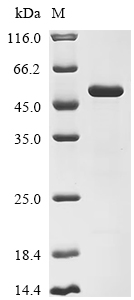
Greater than 85% as determined by SDS-PAGE.
Target Names
Atg4b
Uniprot NO.
Research Area
Cancer
Species
Mus musculus (Mouse)
Source
E.coli
Expression Region
1-393aa
Target Protein Sequence
MDAATLTYDTLRFAEFEDFPETSEPVWILGRKYSIFTEKDEILSDVASRLWFTYRRNFPAIGGTGPTSDTGWGCMLRCGQMIFAQALVCRHLGRDWRWTQRKRQPDSYFNVLNAFLDRKDSYYSIHQIAQMGVGEGKSIGQWYGPNTVAQVLKKLAVFDTWSSLAVHIAMDNTVVMEEIRRLCRANLPCAGAAALPTDSERHCNGFPAGAEVTNRPSAWRPLVLLIPLRLGLTDINEAYVETLKHCFMMPQSLGVIGGKPNSAHYFIGYVGEELIYLDPHTTQPAVELTDSCFIPDESFHCQHPPSRMGIGELDPSIAVGFFCKTEEDFNDWCQQVKKLSQLGGALPMFELVEQQPSHLACQDVLNLSLDSSDVERLERFFDSEDEDFEILSL
Note: The complete sequence may include tag sequence, target protein sequence, linker sequence and extra sequence that is translated with the protein sequence for the purpose(s) of secretion, stability, solubility, etc.
If the exact amino acid sequence of this recombinant protein is critical to your application, please explicitly request the full and complete sequence of this protein before ordering.
Mol. Weight
49.4 kDa
Protein Length
Full Length
Tag Info
N-terminal 10xHis-tagged and C-terminal Myc-tagged
The tag type will be determined during production process. If you have specified tag type, please tell us and we will develop the specified tag preferentially.
Form
Liquid or Lyophilized powder
Note: We will preferentially ship the format that we have in stock, however, if you have any special requirement for the format, please remark your requirement when placing the order, we will prepare according to your demand.
Buffer
If the delivery form is liquid, the default storage buffer is Tris/PBS-based buffer, 5%-50% glycerol. If the delivery form is lyophilized powder, the buffer before lyophilization is Tris/PBS-based buffer, 6% Trehalose.
Reconstitution
We recommend that this vial be briefly centrifuged prior to opening to bring the contents to the bottom. Please reconstitute protein in deionized sterile water to a concentration of 0.1-1.0 mg/mL.We recommend to add 5-50% of glycerol (final concentration) and aliquot for long-term storage at -20℃/-80℃. Our default final concentration of glycerol is 50%. Customers could use it as reference.
Storage
The shelf life is related to many factors, storage state, buffer ingredients, storage temperature and the stability of the protein itself. Generally, the shelf life of liquid form is 6 months at -20°C/-80°C. The shelf life of lyophilized form is 12 months at -20°C/-80°C.
Shelf Life
The shelf life is related to many factors, storage state, buffer ingredients, storage temperature and the stability of the protein itself.
Generally, the shelf life of liquid form is 6 months at -20°C/-80°C. The shelf life of lyophilized form is 12 months at -20°C/-80°C.
Lead Time
3-7 business days
Note: All of our proteins are default shipped with normal blue ice packs, if you request to ship with dry ice, please communicate with us in advance and extra fees will be charged.
Notes
Repeated freezing and thawing is not recommended. Store working aliquots at 4℃ for up to one week.
Troubleshooting and FAQs
Datasheet & COA
Please contact us to get it.
Images
  • (Tris-Glycine gel) Discontinuous SDS-PAGE (reduced) with 5% enrichment gel and 15% separation gel.

Customer Reviews and Q&A

 Customer Reviews

Target Background

Function(From Uniprot)
Cysteine protease required for the cytoplasm to vacuole transport (Cvt) and autophagy. Cleaves the C-terminal amino acid of ATG8 family proteins MAP1LC3, GABARAPL1, GABARAPL2 and GABARAP, to reveal a C-terminal glycine. Exposure of the glycine at the C-terminus is essential for ATG8 proteins conjugation to phosphatidylethanolamine (PE) and insertion to membranes, which is necessary for autophagy. Has also an activity of delipidating enzyme for the PE-conjugated forms.
Gene References into Functions
  1. At the microtubule-actin crossover junction, ATG4B detaches LC3B from melanosomal membranes by enzymatic delipidation. PMID:28598240
  2. ATG4B contains a C-terminal LIR motif important for binding and efficient cleavage of mammalian orthologs of yeast Atg8 PMID:28287329
  3. miR-34a might regulate the autophagic activity and can cause injury in ischemia reperfusion injured renal tubular epithelial cells (RTEC) via targeting Atg4B. Atg4B knockdown inhibited autophagy in RTECs. PMID:26406385
  4. the ATG4B protease and autophagy play a crucial role protecting epithelial cells against bleomycin-induced stress and apoptosis PMID:25906080
  5. REDD1/TXNIP complex expression is sufficient to induce reactive oxygen species, suppress ATG4B activity and activate autophagy. PMID:25916556
  6. these findings demonstrate a role for Ser-383 and Ser-392 phosphorylation of ATG4B in control of autophagy. PMID:26378241
  7. mTOR inhibition alleviates Huntington's disease progression by inducing Atg4b-dependent autophagic flux. PMID:23861892
  8. An autophagy-related gene, Atg4b, is identified as a de novo target gene of C/EBP BETA and is shown to play an important role in 3T3-L1 adipocyte differentiation. PMID:23754749
  9. The Atg4b participates in polarized secretion of lysosomal contents into the extracellular space by directing lysosomes to fuse with the plasma membrane. PMID:22055344
  10. Genetic inactivation of mouse Atg4b resulted in amorphous globular bodies in the neuropil of the deep cerebellar nuclei and adjacent vestibular nuclei and a mild but measurable impairment of motor performance on the Rotarod. PMID:20634410
  11. The Apg4B/autophagin-1 protease thus serves as a processing/deconjugating enzyme for these four highly divergent mammalian Apg8 homologues, GATE-16, MAP1-LC3, GABARAP, and Apg8L. PMID:14530254
  12. These results show that the lipidation of LC3 paralogues is involved in the completion of autophagosome formation in mammalian cells. PMID:18768752

Show More

Hide All

Subcellular Location
Cytoplasm.
Protein Families
Peptidase C54 family
Database Links
icon of phone
Call us
301-363-4651 (Available 9 a.m. to 5 p.m. CST from Monday to Friday)
icon of address
Address
No. 269, Shendun 5th Road, Donghu Hi-Tech Development Area, Hubei Province, 430206, P.R.China
icon of social media
Join us with

Subscribe newsletter

Leave a message

* To protect against spam, please pass the CAPTCHA test below.
CAPTCHA verification
© 2007-2025 CUSABIO TECHNOLOGY LLC All rights reserved. 鄂ICP备15011166号-1
Select 0 Products