PMFIVNTNVPRASVPEGFLSELTQQLAQATGKPAQYIAVHVVPDQLMTFSGTNDPCALCSLHSIGKIGGAQNRNYSKLLCGLLSDRLHISPDRVYINYYDMNAANVGWNGSTFA
Note: The complete
sequence may include tag sequence, target protein sequence, linker sequence and extra sequence that is
translated with the protein sequence for the purpose(s) of secretion, stability, solubility, etc.
If the exact amino acid sequence of this recombinant protein is critical to your application,
please explicitly request the full and complete sequence of this protein before ordering.
Mol. Weight
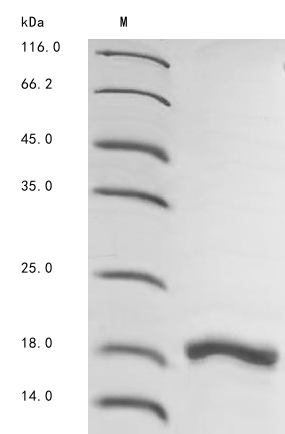
18.4 kDa
Protein Length
Full Length of Mature Protein
Tag Info
N-terminal 10xHis-tagged
The tag type will be determined during production process. If you have specified tag type, please tell us and we will develop the specified tag preferentially.
Buffer
Tris-based buffer,50% glycerol
Storage
The shelf life is related to many factors, storage state, buffer ingredients, storage temperature and the stability of the protein itself.
Generally, the shelf life of liquid form is 6 months at -20°C/-80°C. The shelf life of lyophilized form is 12 months at -20°C/-80°C.
Shelf Life
The shelf life is related to many factors, storage state, buffer ingredients, storage temperature and the stability of the protein itself.
Generally, the shelf life of liquid form is 6 months at -20°C/-80°C. The shelf life of lyophilized form is 12 months at -20°C/-80°C.
Lead Time
3-7 business days
Note: All of our proteins are default shipped with normal blue ice packs, if you request to ship with dry ice, please communicate with us in advance and extra fees will be charged.
Notes
Repeated freezing and thawing is not recommended. Store working aliquots at 4°C for up to one week.
Pro-inflammatory cytokine. Involved in the innate immune response to bacterial pathogens. The expression of MIF at sites of inflammation suggests a role as mediator in regulating the function of macrophages in host defense. Counteracts the anti-inflammatory activity of glucocorticoids. Has phenylpyruvate tautomerase and dopachrome tautomerase activity (in vitro), but the physiological substrate is not known. It is not clear whether the tautomerase activity has any physiological relevance, and whether it is important for cytokine activity.
Gene References into Functions
MIF mediates LPS-induced cardiac dysfunction in murine cardiomyocytes, which was attenuated by MIF knockout.PMID:29350381
MIF attenuates oxygen-glucose deprivation-induced cochlear cells injury. MIF enhances Nrf2 and inhibit oxidative stress in cochlear cells. Enhanced Akt-Nrf2-HO-1 pathway may mediate cochlear protection by MIF.PMID:29908183
Data indicate function of macrophage migration inhibitory factor (MIF) as a regulator of the NLR family pyrin domain containing 3 (NLRP3) inflammasome complex in macrophages.PMID:29884801
that macrophage migration inhibitory factor directly engages in dengue NS1-induced glycocalyx degradation and that targeting MIF may represent a possible therapeutic approach for preventing dengue-induced vascular leakagePMID:29702687
our data suggests a model in which MIF expression in the primary tumor dampens the anti-tumor immune response, promoting tumor growthPMID:29864117
MIF knockdown significantly accentuates hearing loss in young mice.PMID:28990052
Mif mediates PAR4-induced bladder pain through urothelial HMGB1.PMID:29263120
These results show although high systemic levels of MIF contribute to the development of type 2 diabetes mellitus pathology.PMID:28780379
High MIF expression is associated with progressive multiple sclerosis.PMID:28923927
The lack of MIF leads to disturbances of systemic and hippocampal insulin sensitivity, which are possibly responsible for memory deficits and anxiety, most likely through decreased PSA-NCAM-mediated neuroplasticity rather than through neurotrophic factors.PMID:28919555
These data indicate the functional role of the MIF-COX-p53 axis in inflammation and cancer at the genomic and proteomic levels in COX-2-ablated cells.PMID:29247872
Our results showed that MIF regulates MCP-1 expression in hepatocytes of injured liver via CD74, CD44, and p38 MAPK in an autocrine manner.PMID:27273604
MIF is involved in the pathogenesis of AF, probably by down-regulating the protein and gene expression of Cx43 via ERK1/2 kinase activationPMID:28429502
Endogenous MIF reduces the accumulation and toxicity of misfolded SOD1 in a mouse model of amyotrophic lateral sclerosis.PMID:27551074
Gene expression of MIF was 30-fold higher in the heart, compared to skeletal muscle and protein expression of MIF was 3-fold higher in the heart compared to skeletal muscle.PMID:27364992
renal tubular MIF is an endogenous renoprotective factor in progressive kidney diseasesPMID:28801314
locally produced MIF in the inflammatory bone lytic site is engaged in the chemoattraction of circulating CXCR4+ osteoclast precursor cells.PMID:27082509
MIF expression was induced in chondrocytes of tissue-engineered cartilage, and could exert a profound effect on chondrocytes by promoting cartilage maturation. MIF could also regulate the phenotype of surrounding macrophages, impairing the maturation of transplanted tissues.PMID:28574571
pretreatment of P. aeruginosa with rMIF is associated with reduced bacterial killing by tobramycin.PMID:28768722
loss of autophagy, by pharmacological inhibition or siRNA silencing of Atg5, enhances MIF secretion by monocytes and macrophages.PMID:27163877
CHD7 is an important factor in the proliferation and stemness maintenance of neural stem/progenitor cells.PMID:27955690
MIF-deficient mice have reduced Nippostrongylus brasiliensis burden and mounted an enhanced type 2 immune response, including increased Gata3 expression and interleukin-13 production in the mesenteric lymph nodesPMID:27049059
Sertoli cells to produce MIF under normal conditions. MIFR is expressed in GFRalpha1 and Sertoli cells. MIF induced spermatogonial cell migrationPMID:27925200
MIF-transgenic cells exhibited substantially decreased levels of p53 after hyperthermia treatment compared with WT and MIF-knockout cellsPMID:27528627
This study showed that loss of keratinocyte-derived MIF leads to a loss of control of epithelial skin tumor formation in chemical skin carcinogenesis, which highlights an unexpected tumor-suppressive activity of MIF in murine skin.PMID:27825106
This study was undertaken to investigate the potential role of Macrophage migration inhibitory factor in osteoarthritis in human joint tissues and in vivo in mice with age-related and surgically induced osteoarthritisPMID:27564840
MIF (macrophage migrating inhibitory factor), a potential pathogenic molecule in African trypanosomosis, was found herein to promote erythrophagocytosis, to block extramedullary erythropoiesis and RBC maturation, and to trigger hemodilution.PMID:27632207
findings suggest that macrophage migration inhibitory factor regulates extramedullary erythropoiesis by inhibiting an overexpansion of splenic immature erythroid cells during chronic stress and indicate a novel role for this cytokine under chronic stress conditionsPMID:27129368
Findings suggest that Mif plays a role in the molecular mechanisms of macrophage and dendritic cell activation and drives T cell responses involved in the pathology of type 1 diabetes mellitus.PMID:27699180
MIF has a potential role in pathological angiogenesis of proliferative retinopathy.PMID:28070752
genetic Mif deletion reduces the incidence and severity of oral carcinogenesis, by inhibiting the expression of chronic pro-inflammatory immune mediators. Thus, targeting MIF is a promising strategy for the prevention or therapy of oral cancer.PMID:27164411
MIF inhibits the myoblast differentiation by affecting the cell cycle progression, but does not affect proliferation.PMID:26927414
this paper shows that the detrimental effect of MIF knockout was associated with accentuated loss in cardiac autophagy with agingPMID:26940544
our results suggest that MIF promotes mCSC survival, proliferation and endothelial differentiation through the activation of the PI3K/Akt/mTOR and AMPK signaling pathways.PMID:27035848
Posttranslational modification of MIF by S-nitrosation results in intracellular accumulation and protection from myocardial ischemia reperfusion injury.PMID:26310191
Data show that the siRNA-induced macrophage migration inhibitory factor (MIF) reduction in murine mammary cancer line 4T1 and human breast cancer line MDA-MB-231 resulted in significant reduction of cell proliferation and increase of apoptosis.PMID:26403072
High expression levels of macrophage migration inhibitory factor sustain the innate immune responses of neonates.PMID:26858459
The deletion of the MIF gene led to reduced behavioural despair in mice of both sexes and IFN-gamma mRNA levels were reduced in the hippocampus of the MIF KO mice.PMID:26338025
In D-galactosamine-sensitized mice CP+Cu(II) increased the LPS-induced lethality from 54 to 100%, while administration of antibodies against MIF prevented the lethal effect. The enhancement by CP+Cu(II) of the pro-inflammatory signal of MIF is discussed.PMID:26091949
data suggest that the MIF-Notch axis may play an important role in the pathogenesis of experimental autoimmune uveitisPMID:26400205
The functional role of MIF in cell recruitment was investigated by a chemotaxis assay and by flow cytometry of labeled macrophages that were injected into Mif-/-and wildtype micePMID:26348853
these results implicate MIF in the pathogenesis of esophageal inflammation and suggest that targeting MIF might represent a novel therapy for EoE.PMID:25712805
Data suggest that macrophage migration inhibitory factor (MIF) inhibition could be a promising approach to the treatment of diabetes mellitus (DM)-associated atherosclerosis (AS).PMID:25661015
Bladder PAR activation elicits urothelial MIF release and urothelial MIF receptor signaling at least partly through CXCR4 to result in abdominal hypersensitivity without overt bladder inflammationPMID:26020638
Transcription factor MEF2 and Zac1 mediate MIF-induced GLUT4 expression through CD74-dependent AMPK activation in cardiomyocytesPMID:26455966
Blockade of CXCR7 suppressed MIF-mediated ERK- and zeta-chain-associated protein kinase (ZAP)-70 activationPMID:26139098
Macrophage migration inhibitory factor is detrimental for survival and is associated with lung pathology, inflammatory cellular infiltration, and bacterial replication in a mouse model of pneumococcal pneumonia.PMID:25943202
Macrophage migration inhibitory factor may play an important role in recovery from acoustic traumaPMID:25853607
data indicate that MIF and CD74 facilitate RANKL-induced osteoclastogenesis, and suggest that MIF contributes directly to bone erosion, as well as inflammation, in rheumatoid arthritisPMID:25647268
MIF was found to be a major platelet-derived chemotactic recruitment factor with clot-modulating properties and therefore might be relevant in inflammatory diseases such as atherosclerosisPMID:25561410