


Call us
301-363-4651 (Available 9 a.m. to 5 p.m. CST from Monday to Friday)


Multiple sclerosis (MS) is a chronic inflammatory demyelinating disease of the central nervous system (CNS) characterized by a multifocal distribution of white matter in the CNS and remission relapses during the course of the disease, usually involving periventricular white matter, optic nerves, the spinal cord, the brainstem, and the cerebellum.
The pathologic features of multiple sclerosis include inflammatory cell infiltration, neuronal degeneration, axonal damage, and reactive gliosis. Clinical symptoms vary from person to person and may include visual and motor nerve abnormalities, sensory abnormalities, weakness, spasticity, urinary dysfunction, and mild cognitive symptoms, the severity and type of which depend on the areas of the brain and spinal cord affected. Globally, the prevalence of MS is about 3/100,000 with about 3.5 million patients.
Therapeutic drugs for multiple sclerosis mainly include immunosuppressants and immunomodulators, which are able to alleviate the symptoms and slow down the progression of the disease to a certain extent, but it is still difficult to achieve myelin regeneration and neuronal regeneration. The main drug development targets are listed below:
Others such as CD49d (ITGA4), RGMA, CXCL13, CD4, CD6 are also important targets for MS drug development. Drugs against these targets are also in clinical development and have shown some efficacy.
CUSABIO has long been committed to providing researchers with high-quality proteins, antibodies, ELISA kits and other tools for scientific research reagents, and has compiled a series of popular targets related to multiple sclerosis research and related reagent products listed below for your selection:

Measured by its binding ability in a functional ELISA. Immobilized CD22 at 2 μg/ml can bind Anti-CD22 rabbit monoclonal antibody, the EC50 of human CD22 protein is 4.034-4.800 ng/ml.

Measured by its binding ability in a functional ELISA. Immobilized CD40L at 2 μg/ml can bind Anti- CD40L Rabbit Monoclonal Antibody(CSB-RA156386A0HU), the EC50 is 2.353-3.232 ng/ml.
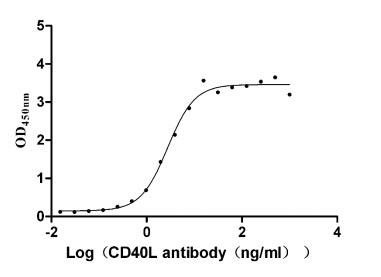
Measured by its binding ability in a functional ELISA. Immobilized CD40L at 2 μg/ml can bind Anti- CD40L Rabbit Monoclonal Antibody(CSB-RA156386A0HU), the EC50 is 2.353-3.232 ng/ml.
-AC1.jpg)
Measured by its binding ability in a functional ELISA. Immobilized Human IL17A at 2 μg/ml can bind Anti-IL17A recombinant antibody (CSB-RA624104MA1HU), the EC50 is 1.818-2.170 ng/mL.

Measured by its binding ability in a functional ELISA. Immobilized Human IL2RA at 2μg/mL can bind Anti-IL2RA recombinant antibody (CSB-RA011649MA1HU),the EC50 is 2.463-3.353 ng/mL.

Measured by its binding ability in a functional ELISA. Immobilized human CD20 at 2 μg/ml can bind Anti-CD20 recombinant antibody (CSB-RA015007A1HU), the EC50 is 3.243-7.085 ng/mL.

Measured by its binding ability in a functional ELISA. Immobilized human SEMA4D at 2 μg/ml can bind biotinylated Pepinemab, the EC50 is 1.005-1.776 ng/mL

Human TNFSF13B protein Fc tag (CSB-MP897523HU1) captured on COOH chip can bind Human BCMA protein Fc tag (CSB-MP023974HU1) with an affinity constant of 39 nM as detected by LSPR Assay.

Tested Applications:
ELISA, WB, IHC, IP

Tested Applications:
ELISA, IF, FC

Tested Applications:
ELISA, WB, IHC, IF, FC

Tested Applications:
ELISA, WB, IHC
| Target | Product Name | Species Reactivity | Tested Applications | Code |
|---|---|---|---|---|
| CCR2 | CCR2 Recombinant Monoclonal Antibody | Human | ELISA, IHC | CSB-RA297464A0HU |
| CD19 | CD19 Recombinant Monoclonal Antibody | Human | ELISA | CSB-RA004888A0HU |
| CD19 | CD19 Recombinant Monoclonal Antibody | Human | ELISA, WB, IHC, IP | CSB-RA780821A0HU |
| CD19 | CD19 Recombinant Monoclonal Antibody | Human, Mouse | ELISA, WB | CSB-RA004888MA1HU |
| CD22 | CD22 Recombinant Monoclonal Antibody | Human | ELISA, IHC | CSB-RA962691A0HU |
| CD3E | CD3E Recombinant Monoclonal Antibody | Human | ELISA, FC | CSB-RA004931MA1HU |
| CD4 | CD4 Recombinant Monoclonal Antibody | Human | ELISA, WB, IHC | CSB-RA004935A0HU |
| CD40 | CD40 Recombinant Monoclonal Antibody | Human | ELISA, IF, FC | CSB-RA004936MA1HU |
| IL17A | IL17A Recombinant Monoclonal Antibody | Human | ELISA | CSB-RA624104MA1HU |
| IL23A | IL23A Recombinant Monoclonal Antibody | Human | ELISA, WB | CSB-RA251959A0HU |
| IL2RA | IL2RA Recombinant Monoclonal Antibody | Human | ELISA, IF | CSB-RA011649MA1HU |
| ITGA4 | ITGA4 Recombinant Monoclonal Antibody | Human | ELISA, WB | CSB-RA225859A0HU |
| ITGAL | ITGAL Recombinant Monoclonal Antibody | Human | ELISA, WB, IF | CSB-RA787996A0HU |
| MCAM | CD146 Recombinant Monoclonal Antibody | Human | ELISA, WB, IHC, IF, FC | CSB-RA013563A0HU |
| MS4A1 | CD20 Recombinant Monoclonal Antibody | Human | ELISA | CSB-RA015007A0HU |
| MS4A1 | MS4A1 Recombinant Monoclonal Antibody | Human | ELISA | CSB-RA015007A1HU |
| MS4A1 | MS4A1 Recombinant Monoclonal Antibody | Human, Dog, Macaca fascicularis | ELISA | CSB-RA015007MA3HU |
| MS4A1 | MS4A1 Recombinant Monoclonal Antibody | Human | ELISA, IHC, IF | CSB-RA015007MA4HU |
| PDCD1 | PDCD1 Recombinant Monoclonal Antibody | Human | ELISA, WB, IHC | CSB-RA240597A0HU |
| PDGFRB | Phospho-PDGFRB (Y740) Recombinant Monoclonal Antibody | Human | ELISA, WB | CSB-RA017713A740phHU |
| PDGFRB | PDGFRB Recombinant Monoclonal Antibody | Human | ELISA, IHC | CSB-RA213932A0HU |
| SEMA4D | SEMA4D Recombinant Monoclonal Antibody | Human | ELISA, FC | CSB-RA835707A1HU |
| SEMA4D | SEMA4D Recombinant Monoclonal Antibody | Human, Mouse | ELISA, FC | CSB-RA835707A2HU |


