Brain Cancer
Brain cancer is a malignant tumor that occurs in the brain, including primary brain cancer and secondary brain cancer. Primary brain cancer originates from brain tissue or neighboring tissues, such as meninges, while secondary brain cancer is formed by metastasis of cancer from other parts of the body to the brain. Brain cancer has diverse symptoms, including headache, nausea, vomiting, visual impairment, seizures, etc. These symptoms are related to the size, location and growth rate of the tumor.
In terms of brain cancer treatment, traditional treatments include surgical resection, radiotherapy and chemotherapy. However, due to the existence of the blood-brain barrier, many drugs are difficult to effectively reach the tumor site in the brain, limiting the therapeutic effect. In recent years, drug research for brain cancer mainly focuses on targeted therapy and immunotherapy.
- Targeted therapy: Targeted therapy drugs inhibit tumor growth and spread by specifically acting on specific molecular targets of tumor cells. For example, the MET inhibitors Capmatinib and Tepotinib have been approved and marketed for the treatment of metastatic non-small cell lung cancer with MET14 exon jumping mutations, while research on MET inhibitors in the field of brain cancer is also underway.
- Immunotherapy: Immunotherapy attacks tumor cells by activating or boosting a patient's own immune system.PD-1/L1 antibody drugs such as Nivolumab and Pembrolizumab have shown potential in some brain cancer treatments, and despite the current unsuccessful Phase III clinical trials for GBM, immunotherapy remains a research hotspot.
- Cellular immunotherapy: Cellular immunotherapy including CAR-T cell therapy and CIK cell therapy, among others, works by modifying a patient's immune cells to enable them to recognize and attack tumor cells. For example, CAR-T products targeting EGFRvIII are being developed to treat GBM1.
- Lysovirus therapy: uses modified viruses to specifically infect and kill tumor cells. For example, the HSV-1-based modified lysosomal virus G207 has shown prolonged survival in clinical trials for the treatment of high-grade gliomas in children and adolescents.
Brain Cancer Drug Targets
Brain Cancer Drug Target Related Products
● Target Proteins

Human EGF protein captured on COOH chip can bind Human EGFR protein, his and Myc tag (CSB-MP007479HU) with an affinity constant of 11.9nM as detected by LSPR Assay.

Measured by its binding ability in a functional ELISA. Immobilized CD276 at 2 μg/ml can bind Anti-CD276 rabbit monoclonal antibody, the EC50 of human CD276 protein is 1.961-2.243 ng/ml.
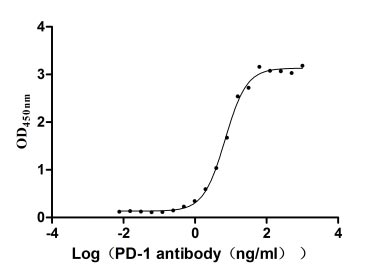
Measured by its binding ability in a functional ELISA. Immobilized PD-1 at 2 μg/ml can bind Anti-PD-1 recombinant antibody, the EC50 of human PD-1 protein is 6.087-7.854 ng/ml.

Measured by its binding ability in a functional ELISA. Immobilized HER2 at 2 μg/ml can bind Trastuzumab, the EC50 is 2.179-2.825 ng/ml.

Measured by its binding ability in a functional ELISA. Immobilized PD-L1 at 2 μg/ml can bind Anti- PD-L1 mouse monoclonal antibody(CSB-MA878942A1m, antigen from E.coli), the EC50 of human PD-L1 protein is 1.252-1.653 ng/mL

Measured by its binding ability in a functional ELISA. Immobilized TNFSF9 at 2 μg/ml can bind TNFRSF9(CSB-MP023984HU1), the EC50 is 2.671-3.702 ng/mL
-AC1.jpg)
Measured by its binding ability in a functional ELISA. Immobilized Human ANGPT2 at 2 μg/ml can bind anti-ANGPT2 recombinant antibody(CSB-RA001707MA01HU), the EC50 is 0.6666-0.8876 ng/mL
-AC1.jpg)
FACS assay shows that Human PVR can bind to HEK293F cell overexpressing human TIGIT.
| Product Name |
Code |
Target |
Source |
Tag Info |
| Recombinant Human Angiopoietin-2 (ANGPT2) (Active) |
CSB-MP001707HU(A4) |
ANGPT2 |
Mammalian cell |
C-terminal 10xHis-tagged |
| Recombinant Dog Angiopoietin-2 (ANGPT2) (Active) |
CSB-MP001707DO |
ANGPT2 |
Mammalian cell |
C-terminal 6xHis-tagged |
| Recombinant Human Programmed cell death 1 ligand 1 (CD274), partial (Active) |
CSB-MP878942HU1 |
CD274 |
Mammalian cell |
C-terminal hFc-tagged |
| Recombinant Human CD276 antigen (CD276), partial (Active) |
CSB-MP733578HU |
CD276 |
Mammalian cell |
C-terminal hFc-Myc-tagged |
| Recombinant Human Leukocyte surface antigen CD47 (CD47), partial (Active) |
CSB-AP005201HU |
CD47 |
Mammalian cell |
C-terminal 6xHis-tagged |
| Recombinant Human Leukocyte surface antigen CD47 (CD47), partial (Active) |
CSB-AP005211HU |
CD47 |
Mammalian cell |
C-terminal Fc-tagged |
| Recombinant Human Leukocyte surface antigen CD47 (CD47), partial (Active) |
CSB-MP004940HU |
CD47 |
Mammalian cell |
C-terminal hFc-tagged |
| Recombinant Human Carcinoembryonic antigen-related cell adhesion molecule 5 (CEACAM5) (E398K) (Active) |
CSB-MP005165HU |
CEACAM5 |
Mammalian cell |
C-terminal 10xHis-tagged |
| Recombinant Human Granulocyte-macrophage colony-stimulating factor receptor subunit alpha (CSF2RA), partial (Active) |
CSB-AP003591HU |
CSF2RA |
Mammalian cell |
C-terminal 6xHis-tagged |
| Recombinant Human Epidermal growth factor receptor (EGFR), partial (Active) |
CSB-MP007479HU |
EGFR |
Mammalian cell |
N-terminal 10xHis-tagged and C-terminal Myc-tagged |
| Recombinant Human Receptor tyrosine-protein kinase erbB-2 (ERBB2), partial (Active) |
CSB-MP007763HU |
ERBB2 |
Mammalian cell |
C-terminal 6xHis-tagged |
| Recombinant Human Receptor tyrosine-protein kinase erbB-3 (ERBB3), partial (Active) |
CSB-MP007765HU |
ERBB3 |
Mammalian cell |
C-terminal hFc-tagged |
| Recombinant Human Fibronectin (FN1), partial (Active) |
CSB-AP005751HU |
FN1 |
E.coli |
Tag-Free |
| Recombinant Human Interleukin-2 receptor subunit alpha (IL2RA), partial (Active) |
CSB-MP011649HU3 |
IL2RA |
Mammalian cell |
C-terminal 10xHis-tagged |
| Recombinant Human Interleukin-4 receptor subunit alpha (IL4R), partial (Active) |
CSB-AP004271HU |
IL4R |
Mammalian cell |
C-terminal 6xHis-tagged |
| Recombinant Human Interleukin-4 receptor subunit alpha (IL4R), partial (Active) |
CSB-AP004281HU |
IL4R |
Mammalian cell |
C-terminal Fc-tagged |
| Recombinant Human Interleukin-4 receptor subunit alpha (IL4R), partial,Biotinylated (Active) |
CSB-MP011661HU2-B |
IL4R |
Mammalian cell |
C-terminal 10xHis-Avi-tagged |
| Recombinant Human B-lymphocyte antigen CD20 (MS4A1)-VLPs (Active) |
CSB-MP015007HU |
MS4A1 |
Mammalian cell |
C-terminal 10xHis-tagged (This tag can be tested only under denaturing conditions) |
| Recombinant Dog B-lymphocyte antigen CD20 (MS4A1)-VLPs (Active) |
CSB-MP661636DO |
MS4A1 |
Mammalian cell |
C-terminal 10xHis-tagged (This tag can be tested only under denaturing conditions) |
| Recombinant Macaca fascicularis Membrane spanning 4-domains A1 (MS4A1)-VLPs (Active) |
CSB-MP4516MOV |
MS4A1 |
Mammalian cell |
C-terminal 10xHis-tagged (This tag can be tested only under denaturing conditions) |
| Recombinant Human Programmed cell death protein 1 (PDCD1), partial (Active) |
CSB-MP619964HU1 |
PDCD1 |
Mammalian cell |
C-terminal 6xHis-tagged |
| Recombinant Human Poliovirus receptor (PVR) (I340M), partial (Active) |
CSB-MP019093HU(M) |
PVR |
Mammalian cell |
C-terminal hFc-tagged |
| Recombinant Human Transforming growth factor beta-1 proprotein (TGFB1), partial (Active) |
CSB-AP003861HU |
TGFB1 |
Mammalian cell |
Tag-Free |
| Recombinant Mouse Transforming growth factor beta-1 proprotein (Tgfb1), partial (Active) |
CSB-AP004111MO |
Tgfb1 |
Mammalian cell |
Tag-Free |
| Recombinant Human Tumor necrosis factor receptor superfamily member 1A (TNFRSF1A), partial (Active) |
CSB-MP023977HU1 |
TNFRSF1A |
Mammalian cell |
C-terminal hFc-tagged |
| Recombinant Human Tumor necrosis factor ligand superfamily member 9 protein (TNFSF9), partial (Active) |
CSB-AP001961HU |
TNFSF9 |
E.Coli |
Tag-Free |
| Recombinant Human Tumor necrosis factor ligand superfamily member 9 (TNFSF9), partial (Active) |
CSB-MP023997HU1 |
TNFSF9 |
Mammalian cell |
N-terminal hFc-Myc-tagged |
● Recombinant antibodies

Overlay Peak curve showing Hela cells surface stained with CSB-RA878942MA1HU (red line) at 1:100.

Overlay Peak curve showing JK cells surface stained with CSB-RA004931MA1HU (red line) at 1:100.

Overlay histogram showing Jurkat cells stained with CSB-RA159341A0HU (red line) at 1:50.

Overlay Peak curve showing 3T3 cells stained with CSB-RA919940A0HU (red line) at 1:50.